WORLD
WORLD
St. Sabas

St. Sabas is best known as one of the great monastic saints of the Christian East, especially in the traditions of Byzantine and Eastern Orthodox Christianity. He was a historical ascetic and monastic founder of the 5th and 6th centuries, remembered for his spiritual discipline, his role in organizing monastic life in Palestine, and his enduring influence on the liturgical and devotional life of the Church. In English, the name is often rendered as Sabas, though older forms and spellings vary by language and tradition.
Historical and religious setting
St. Sabas lived in a period when Christianity was developing new forms of ascetic life in the eastern Mediterranean. The deserts and wilderness areas of Egypt, Palestine, Syria, and nearby regions became associated with hermits, monks, and spiritual teachers who sought solitude, prayer, fasting, and detachment from worldly life. These men and women were not inventing monasticism from nothing; rather, they were building on earlier Christian ascetic practices and shaping them into more organized communities.
In this setting, Palestine became a major center of monastic activity. The region around Jerusalem, the Judean Desert, and the Jordan Valley attracted monks from different backgrounds and languages. Sabas emerged as one of the most influential figures in this world. He is remembered not simply as a recluse, but as a founder and organizer whose monastery helped define the later tradition of Palestinian monasticism.
Life and identity
Sabas was born in Cappadocia, in what is now central Turkey, in the mid-5th century. Ancient and medieval sources give his life in the context of the Eastern Roman Empire, and his biography places him within a Christian family. As a child, he entered monastic life at an early age, which later hagiographic tradition presents as a sign of exceptional calling. He traveled to Palestine as a young monk and eventually settled in the Judean wilderness, where he spent many years in ascetic practice.
The most important source for his life is a hagiographical biography traditionally associated with Cyril of Scythopolis, a 6th-century monk and writer who produced several Lives of Palestinian holy men. As with many saints’ lives, the text combines historical memory, devotional interpretation, and the rhetorical aims of hagiography. It is therefore a valuable witness to Sabas’s reputation and influence, though not a modern biography in the critical sense. Some details are securely anchored in the historical context; others reflect the saintly ideals of the genre.
He is usually identified as St. Sabas the Sanctified or Sabas of Jerusalem in Eastern Christian tradition, not to be confused with other saints or local holy men who share similar names. The title “the Sanctified” reflects his status as a revered monastic founder rather than a formal ecclesiastical office.
Monastic life and foundation
According to tradition, Sabas first lived as a hermit, practicing solitary prayer and severe ascetic discipline in the desert. Over time, other monks gathered around him, seeking guidance and spiritual direction. This development is characteristic of a broader pattern in early monasticism: a charismatic ascetic begins in solitude, and a community gradually forms around his reputation for holiness and practical wisdom.
The monastery most closely associated with him is the Great Lavra of St. Sabas, often known simply as Mar Saba. Located in the Kidron Valley in the Judean Desert, it became one of the most famous monastic sites in the Christian East. The term “lavra” refers to a monastic settlement that combines solitary cells with a shared liturgical center. This mixed form of life suited monks who wanted both the discipline of the desert and the stability of communal worship.
Sabas is credited with shaping the life of this monastery and helping establish a model that balanced individual asceticism with common prayer, obedience, and liturgical order. His influence extended beyond one community, since monastic houses in Palestine and beyond looked to his example for guidance.
Appearance, symbols, and attributes
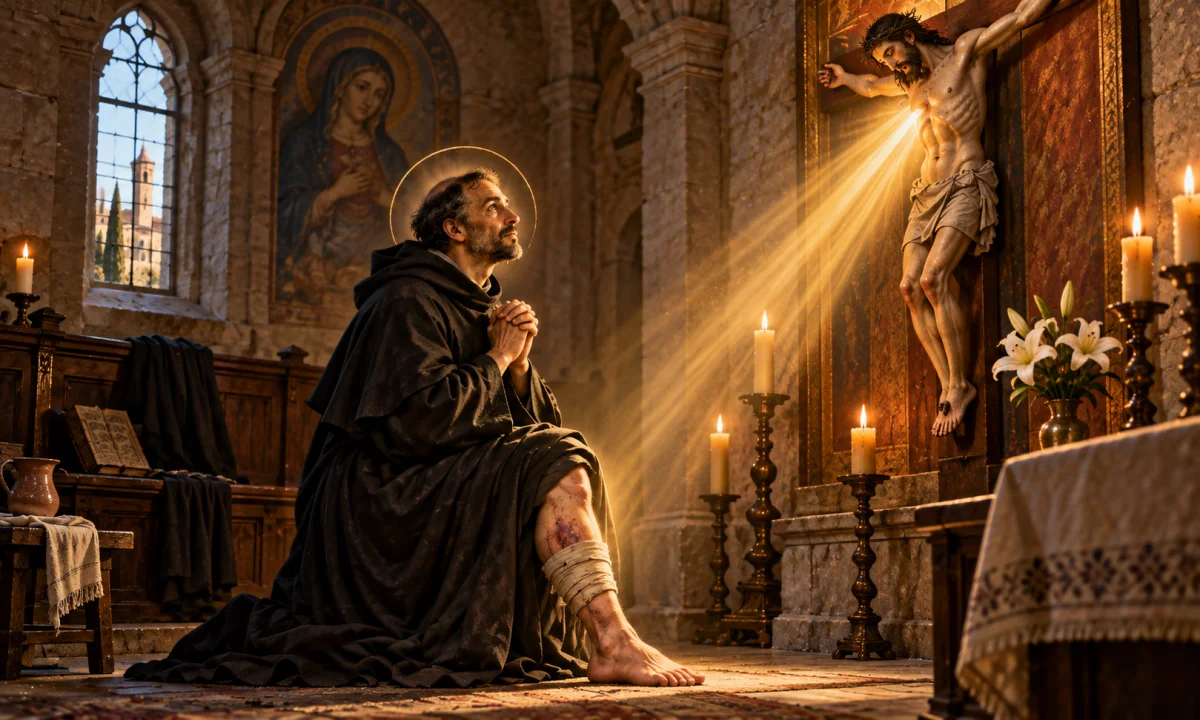
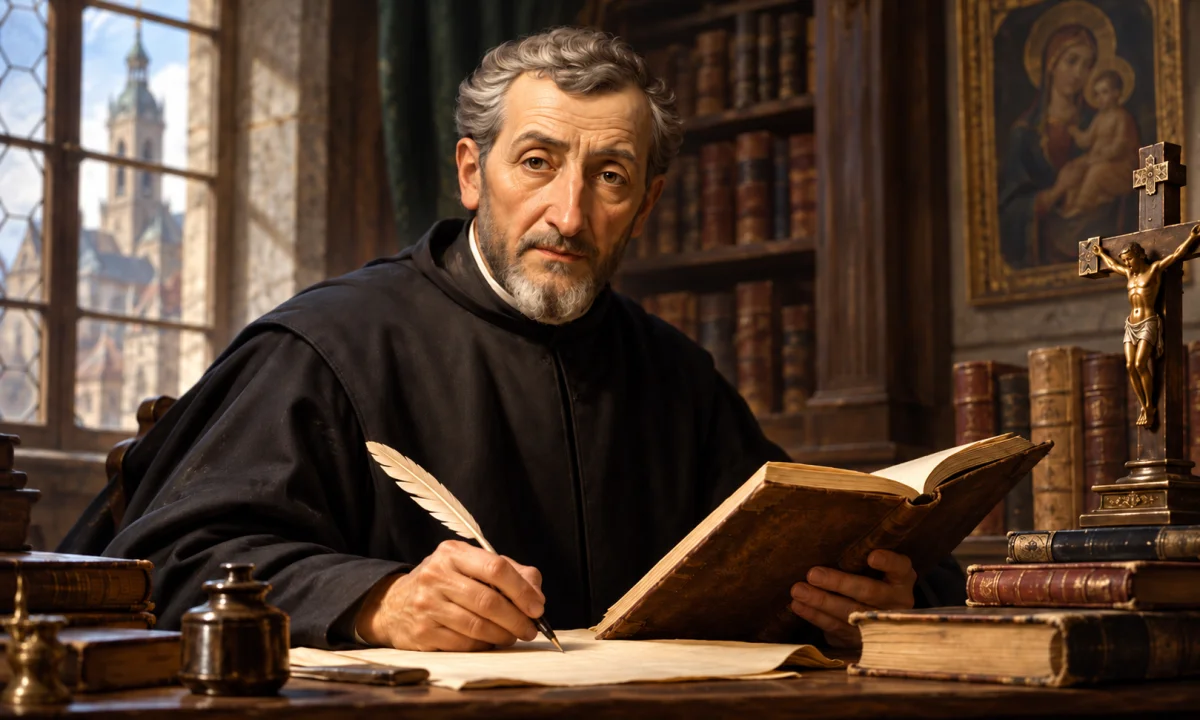
In Christian iconography, St. Sabas is usually shown as an elderly monk with a long beard, dressed in the habit of an Eastern monk. He may be depicted holding a scroll, a cross, or sometimes a staff. These are conventional symbols of monastic authority and spiritual teaching rather than unique historical objects tied to him personally.
His chief symbolic associations are with the desert, withdrawal from the world, discipline, and liturgical order. Unlike warrior saints or miracle-working martyrs whose stories emphasize dramatic acts, Sabas represents the holiness of long endurance, prayer, and institutional formation. In this sense, his sanctity is both contemplative and practical: he is revered as a holy man and as a builder of communities.
Stories and traditions
The surviving traditions about Sabas describe several familiar themes in saintly biography. He is portrayed as a man of great ascetic rigor, prayerful patience, and spiritual discernment. The stories emphasize his resistance to temptation, his care for fellow monks, and his ability to guide others in difficult circumstances.
One recurring theme is his relationship with pilgrims, monks, and laypeople who came to him for advice or blessing. Such stories reflect the way desert saints could become spiritual authorities far beyond their immediate surroundings. Their remoteness did not isolate them completely; instead, it often increased their reputation as people who had renounced ordinary life and therefore possessed special wisdom.
Another important tradition concerns his role in ecclesiastical and doctrinal conflicts of the time. Sabas lived during an era of intense theological controversy, especially after the Council of Chalcedon in 451. Christian communities in the eastern empire were divided over Christological debates, and Palestinian monasticism was not exempt from these tensions. Sabas is remembered in tradition as a defender of orthodox teaching, though the exact details of his involvement should be read within the context of hagiographical writing and later church memory.
His interactions with bishops and imperial officials also appear in the tradition. Like many prominent monks, he was not merely a private ascetic but a public religious figure whose authority could matter in wider church politics. These accounts show how monastic holiness and ecclesiastical leadership could intersect in late antiquity.
Relationship to the Holy Land
Sabas’s life is deeply tied to the geography and sacred imagination of the Holy Land. The Judean Desert, with its harsh landscape and sparse resources, became in Christian thought a place of testing, purification, and encounter with God. By founding and strengthening a monastery there, Sabas helped turn the desert into a living Christian landscape marked by prayer, hospitality, and scriptural memory.
This connection to place is significant. In Christian tradition, the Holy Land is not only a biblical setting but also a continuing arena of sanctified memory. Monastic communities such as the one associated with Sabas preserved liturgical customs, theological learning, manuscript culture, and pilgrimage networks. His monastery became part of the historical fabric of Christian Jerusalem and the surrounding region.
Death and veneration
Sabas died in the early 6th century, traditionally in 532. After his death, his reputation for sanctity continued to grow, and his monastery remained a major center of Eastern Christian monasticism. His relics and memory were honored in the devotional life of the church, and his feast became established in liturgical calendars.
He is venerated especially in Eastern Orthodox, Eastern Catholic, and broader Byzantine Christian traditions. In the liturgy and hymnography of these churches, he is remembered as a model monk and desert father, a figure whose life exemplifies repentance, vigilance, humility, and steadfast prayer. The specifics of his feast day can vary by calendar tradition, including differences between Julian and Gregorian observance.
Interpretation and significance
St. Sabas matters for more than his personal holiness. He represents a major stage in the development of Christian monasticism. Early ascetics were often admired for withdrawing from society, but the growth of monastic communities required organization, discipline, and stable leadership. Sabas is remembered as someone who united these dimensions: the solitary quest for God and the communal shaping of religious life.
His significance also lies in the way monastic saints functioned as guardians of doctrinal and liturgical identity. In late antiquity, monks were often seen as protectors of orthodoxy and exemplars of Christian seriousness. Their authority did not come from office alone, but from reputation, ascetic labor, and perceived closeness to God. Sabas belongs to this tradition of saintly leadership.
From a historical perspective, his life reflects the interaction of spirituality, institution-building, and politics in the Byzantine world. Monasteries were not isolated huts in the desert; they were connected to bishops, cities, pilgrimage routes, and imperial structures. Sabas’s career illustrates how a holy man could become a lasting institutional founder while still being celebrated as an ascetic recluse.
Distinction from other figures named Sabas or Sava
Confusion sometimes arises because several saints and historical figures bear similar names. The best-known St. Sabas in Eastern Christianity is the Palestinian monk described here. He should not be confused with St. Sava of Serbia, the 13th-century Serbian archbishop and national patron saint, whose name is related but whose life and historical context are entirely different.
Other saints named Sabbas, Saba, Savas, or similar forms appear in different languages and calendars. Some may be martyrs, bishops, or local holy men. Because naming conventions vary across Greek, Slavonic, Arabic, Latin, and modern English traditions, careful identification is necessary. When a source refers simply to “Sabas” or “Sava,” the surrounding context usually determines which figure is meant.
Later reception in Christian tradition
The monastery associated with Sabas remained important long after his death, becoming one of the most renowned monasteries in the Christian East. Its liturgical and literary life influenced later monastic culture, and its continued presence helped preserve his memory across centuries of political change in the Holy Land.
In hymnography, iconography, and monastic literature, Sabas became a type of the desert saint: silent, steadfast, and authoritative without worldly power. He appears in the tradition not as a miracle worker in the spectacular sense, but as a holy elder whose life gave shape to a whole way of Christian existence. For monks and nuns, his example offered a pattern of disciplined prayer and communal fidelity. For the wider church, he represented the spiritual prestige of the desert and the enduring importance of monastic wisdom.
In modern Orthodox and Catholic contexts, his name continues to be associated with monastic renewal and with the historic monasteries of the Judean Desert. Pilgrims and visitors to the site known as Mar Saba encounter not only a landmark of architectural and historical interest, but also a living memory of the ascetic tradition shaped by Sabas and his successors.
Common themes in his tradition
- Asceticism: severe discipline, fasting, prayer, and renunciation of ordinary comforts.
- Desert spirituality: the wilderness as a place of testing and divine encounter.
- Monastic organization: the move from solitary life to structured communal worship.
- Orthodoxy and ecclesiastical influence: the role of monks in doctrinal and church affairs.
- Spiritual fatherhood: guidance offered to monks, pilgrims, and other seekers.
Name and linguistic forms
The name appears in several forms depending on language and transliteration. English often uses Sabas, while Greek and Slavic traditions may use forms closer to Sabbas or Sava. These variants do not necessarily indicate different individuals. They reflect the movement of the saint’s cult across linguistic and cultural boundaries.
Because the saint is known primarily through Eastern Christian tradition, modern English readers may encounter his name in connection with Byzantine liturgy, monastic history, or the monastery of Mar Saba. All of these references point back to the same historic ascetic and founder who became one of the most influential monastic saints of the Holy Land.
Modern cultural relevance
St. Sabas does not have a large presence in mainstream popular culture, but he remains relevant in religious tourism, scholarship, and liturgical life. His monastery is still a site of interest for historians, archaeologists, pilgrims, and visitors to the Judean Desert. In church calendars and monastic communities, his memory continues to mark the enduring place of desert spirituality in Christianity.
Where modern references do appear, they usually concern the monastery itself, the history of Palestinian monasticism, or the broader spiritual ideal associated with desert saints. Unlike legendary figures whose traditions have been heavily adapted in novels, films, or games, Sabas is mainly encountered through worship, hagiography, historical study, and the living traditions of Eastern Christianity.