WORLD
WORLD
St. Rupert Mayer

St. Rupert Mayer (1876–1945) was a German Jesuit priest, preacher, and anti-Nazi resister who was venerated as a saint in the Roman Catholic tradition and canonized by Pope John Paul II in 1987. He does not belong to mythology in the ancient or folkloric sense, but to modern Christian sanctity: his significance lies in his religious witness, pastoral work, and public opposition to National Socialism. In Catholic memory, he is remembered as a confessor of the faith, a man whose preaching, charity, and imprisonment became part of his holiness.
Identity and historical setting
Rupert Mayer was born in 1876 in Stuttgart, in what was then the Kingdom of Württemberg. He entered the Society of Jesus, the Catholic religious order known as the Jesuits, and was ordained a priest. His life unfolded in the late nineteenth and early twentieth centuries, a period shaped by industrialization, political upheaval, the First World War, the Weimar Republic, and the rise of National Socialism in Germany. Unlike the saints of the early Church, Mayer’s life is documented by modern historical records, letters, sermons, and eyewitness testimony.
His sainthood is therefore rooted not in legend developed over centuries, but in historically traceable acts of ministry and resistance. He is a figure of modern Catholic martyrdom by confession, though he was not executed. In Catholic usage, “martyr” has a strict meaning, and Mayer is more precisely honored as a confessor and witness who suffered imprisonment and restriction for his faith and conscience.
Religious vocation and Jesuit identity
The Jesuit tradition shaped Mayer’s public role. The Society of Jesus is marked by education, preaching, spiritual direction, and a special emphasis on disciplined obedience and practical engagement with the world. Mayer became known for his pastoral energy, his direct sermons, and his tireless attention to ordinary Catholics, especially in Munich. He is often associated with the idea of the “street priest,” a pastor who took religion beyond the pulpit and into everyday life.
His identity as a Jesuit matters because Jesuits have frequently been involved in education and intellectual life, but Mayer became especially famous for pastoral courage rather than academic scholarship. His work combined care for the poor, spiritual counsel, and public preaching. That combination later made him especially dangerous to the Nazi regime, which distrusted independent religious voices that could command public loyalty.
Ministry in Munich
Mayer spent much of his ministry in Munich, where he became well known as a preacher and confessor. He served in churches and was admired for his ability to communicate clearly and urgently. He drew large congregations, and his sermons were noted for their moral seriousness and practical concern. He also worked with social and charitable initiatives, giving his ministry a strong public and urban character.
His reputation rested not on spectacular miracles or visionary experiences, but on consistency: preaching, hearing confessions, offering counsel, and helping the needy. In Catholic saintly tradition, such daily fidelity can be as important as dramatic episodes. Mayer’s holiness was seen in his steady commitment to conscience and duty under increasing political pressure.
Opposition to National Socialism
Mayer’s best-known historical role is his resistance to Nazi ideology. He opposed the regime’s attempts to subordinate the Church and to replace Christian teaching with racial and totalitarian doctrine. As a priest, he spoke publicly against ideas that were incompatible with Catholic teaching, including the deification of the state and the persecution of human beings on ideological grounds.
This opposition brought him into conflict with the authorities. He was arrested and imprisoned by the Nazis. His case became emblematic of the broader struggle between the German churches and the regime, though that struggle was complex and varied among individuals and institutions. Mayer’s significance comes from the clarity of his witness: he did not remain silent when public faith and human dignity were threatened.
It is important to distinguish his role from that of legendary saintly warriors or miracle-workers. Mayer’s heroism was moral and pastoral, not military or magical. His confrontation with National Socialism belongs to modern political and religious history, not to folklore. That historical context is central to understanding why he is honored today.
Imprisonment and restricted ministry
Mayer was repeatedly targeted by the Nazi state. After imprisonment, he was eventually confined and restricted in ways intended to silence him. The regime recognized that his influence came from public preaching and personal credibility, and it tried to prevent him from exercising those powers. Even so, he continued to be remembered as a source of encouragement to Catholics who resisted fear and compromise.
His suffering under the regime is part of his saintly image in Catholic tradition. He endured deprivation and loss of freedom without abandoning his priestly identity. In hagiographic terms, this places him among those whose sanctity was revealed in persecution. In historical terms, it demonstrates the consequences of religious dissent under dictatorship.
Death and legacy
Rupert Mayer died in 1945, shortly after the collapse of the Nazi regime. His death occurred in Munich, the city with which his ministry is most closely associated. After his death, memory of him grew among German Catholics and beyond, especially because his life connected sanctity with public courage during one of Europe’s darkest periods.
His canonization in 1987 formally recognized what many Catholics had already believed: that he had lived heroically in faith, charity, and fortitude. Canonization in the Catholic Church is a declaration that a person may be publicly venerated as a saint. For Mayer, this recognition affirmed both his spiritual life and his resistance to injustice.
Attributes and symbolism
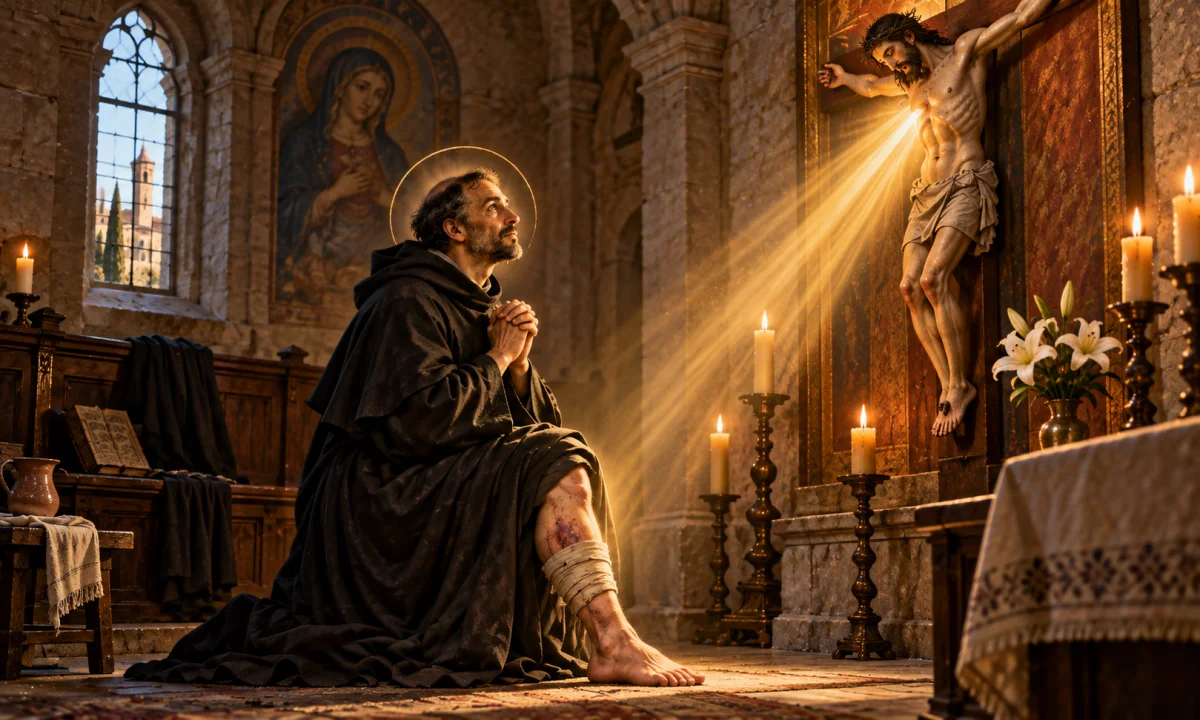
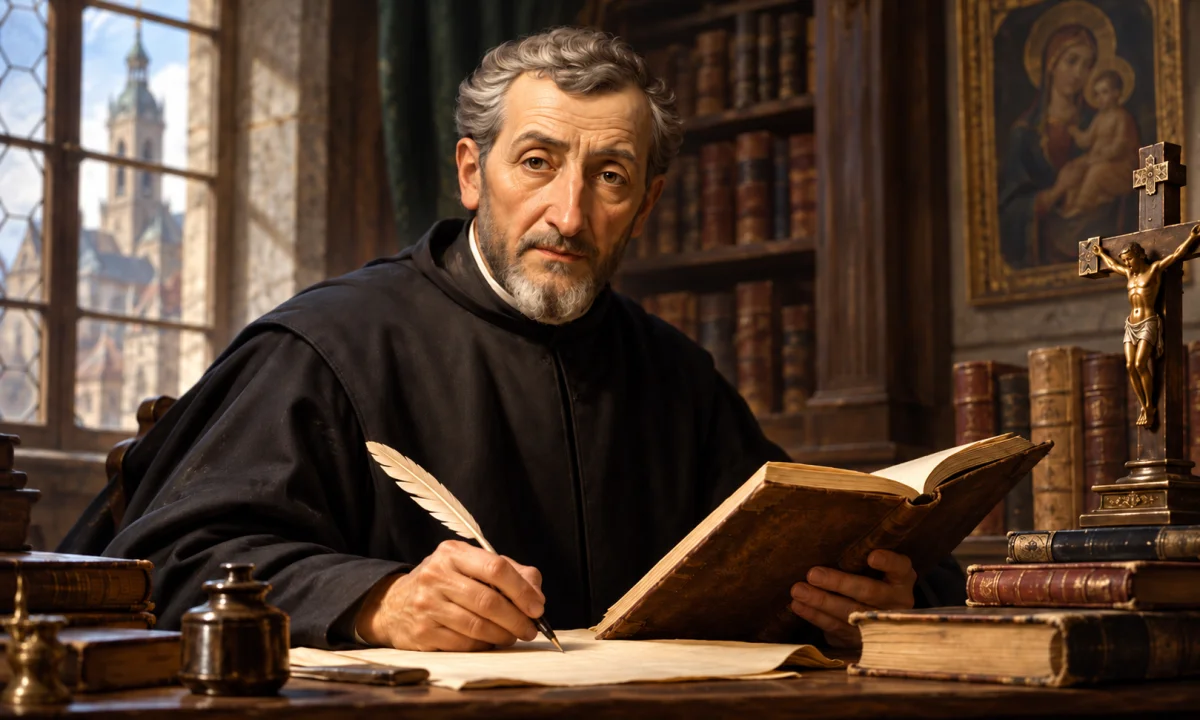
Unlike older saints whose iconography developed around repeated miracles or legendary emblems, Mayer’s visual symbolism is comparatively straightforward. He is commonly shown as a Jesuit priest, often in clerical dress, and sometimes with references to preaching or public ministry. His symbolism arises mainly from his historical role: courage, conscience, and steadfastness under oppression.
In devotional memory, several themes recur:
- Priestly service, especially preaching and confession
- Pastoral closeness, reflected in his care for ordinary people
- Resistance to totalitarian ideology
- Endurance in imprisonment and restriction
- Conscience guided by Catholic teaching rather than political pressure
He is not associated with a stock set of miraculous powers. Any attempt to present him as a wonder-working saint would distort his historical identity. His importance lies in witness, not supernatural display.
Relationship to Catholic martyr and confessor traditions
Mayer belongs to a broader Catholic tradition of saints who suffered for fidelity to the faith. This tradition includes martyrs killed for their belief and confessors who suffered without being put to death. Catholic memory often places great emphasis on both categories. Mayer is especially meaningful because his life shows how sanctity can be lived in a modern political state, not only in ancient persecution.
His example also resonates with Catholic social teaching. His concern for people in need, his resistance to racial and ideological oppression, and his refusal to surrender Christian principles all align with the Church’s defense of human dignity. For many believers, he represents the priest as moral witness in public life.
Historical sources and reliability
Because Mayer lived in the modern era, the surviving evidence for his life is comparatively rich. His sermons, public actions, imprisonment, and death are matters of historical record. That makes him different from figures whose lives are known mainly through legend, oral tradition, or hagiographic embellishment. Nevertheless, as with many saintly lives, devotional biographies may present his character in idealized form, emphasizing virtue and courage while simplifying more complex aspects of his life and times.
It is also worth noting that memories of resistance to Nazism can be shaped by later Catholic and national narratives. Mayer’s example is historically real, but the meanings attached to him may vary. Some emphasize his Jesuit identity, others his public anti-Nazi stance, and others his pastoral work among Munich Catholics. These are not contradictory, but they reflect different ways of reading the same life.
Distinction from similar figures
Rupert Mayer should not be confused with other saints and holy figures who share the name Rupert or similar Germanic forms. He is distinct from medieval Bishop Rupert of Salzburg, a much earlier saint associated with the Christianization of Bavaria and Salzburg. The two men belong to different centuries, different historical contexts, and different forms of sanctity. Mayer is a twentieth-century Jesuit; the other Rupert is an early medieval missionary bishop.
He should also not be conflated with any legendary or folkloric “Father Rupert” type figure that appears in local stories. Mayer’s identity is precise and historical. If his name appears in devotional settings, it refers to the Jesuit priest from Munich, not to a generalized saintly archetype or to an older regional legend.
Interpretation in modern Catholic memory
Modern Catholic devotion to Mayer often presents him as a model for Christians facing political pressure, ideological conformity, or social intimidation. His life speaks to the question of how faith should engage public life. He is sometimes remembered as a saint of courage in the city, someone who understood urban ministry and the dangers of modern mass politics.
His canonization also reflects the twentieth-century Church’s effort to honor those who resisted totalitarian regimes. In that sense, he belongs to a larger group of modern saints and blesseds associated with persecution under fascism and communism. His life is particularly associated with the German Catholic response to Nazism, though his witness has broader relevance.
For believers, Mayer’s example suggests that holiness is not limited to private piety. A saint may be formed in prayer, but that sanctity must also appear in speech, action, and moral judgment. Mayer’s public preaching and refusal to accommodate injustice made him a powerful symbol of integrity.
Place in religious tradition
Within Christian tradition, saints are not only honored as holy individuals; they also serve as patterns of discipleship. Rupert Mayer’s place in that tradition is shaped by the union of priestly ministry and public resistance. He is remembered as a servant of the sacraments, a preacher to the faithful, and a man who would not compromise with a violent ideology.
Unlike many older saints whose stories absorbed miraculous motifs over time, Mayer’s life is anchored in twentieth-century history. That does not make his sanctity less important. If anything, it shows how traditional Christian categories such as witness, confession, sacrifice, and pastoral care continue into the modern age. His name stands for the possibility that holiness can confront modern power without relying on legend.
Why he remains significant
Rupert Mayer remains significant because his life joins faith with public responsibility. He is remembered not for an invented mythic past, but for documented courage in a real political crisis. His story matters to Catholics, historians of the Church, and readers interested in how sainthood functions in modern times.
His life also illustrates the continuing relevance of saintly memory. In Catholic devotion, saints are not remote relics of another world; they are witnesses whose lives address the ethical demands of the present. Mayer’s witness, shaped by preaching, charity, imprisonment, and resistance, continues to speak to questions of conscience, authority, and human dignity.