WORLD
WORLD
St. Rumon Of Tavistock

St. Rumon of Tavistock is a saintly figure associated with medieval Devon and Cornwall, especially the town of Tavistock in Devon. He belongs to the broad tradition of early British and Celtic saints remembered in local devotion, place-names and later hagiography, but his historical identity is uncertain. Surviving references suggest that he was treated as a holy man of the early medieval period, yet the details of his life, date and even exact name vary between sources.
Historical and religious setting
Rumon is part of the wider landscape of Christian sanctity in early Britain, where memory of local holy men and women was preserved through churches, monasteries, dedications and legend. In such traditions, a saint might be remembered not through abundant contemporary records but through later medieval texts, local cult, and the persistence of a name in parish and place-history.
For Tavistock, Rumon became closely linked with the town’s great abbey. Medieval devotion in southwestern Britain often blended monastic history, local identity and the prestige of an ancient founder or patron saint. In that setting, a saint attached to a particular religious house could serve both spiritual and civic purposes: he would provide a focus for prayer, a sense of sacred antiquity and a story of local Christian roots.
The documentary evidence for Rumon is limited. Later writers repeat traditions about him, but there is no securely verified contemporary biography. As with many regional saints from the early medieval British Isles, the surviving tradition is a mixture of memory, ecclesiastical veneration and hagiographical development. Because of that, scholars treat many details cautiously.
Name, identity and uncertainty
The name appears in more than one form, and that variation is important. Rumon is commonly associated with Tavistock, while similar spellings such as Ruman or Rumwold can create confusion in popular retellings. He should not be merged with other saints or legendary children bearing related names. The Tavistock saint is a distinct figure in local tradition, even though the precise historical record is unclear.
The origin of the name is not settled. It may reflect a British or Cornish linguistic background, but there is no universally agreed explanation. Because the medieval record is sparse, it is safest to say that the saint’s name and identity were preserved through local devotion rather than through a full biography that survived intact.
In some traditions he is described as a bishop or confessor; in others he is simply a holy man connected with monastic life. These descriptions are not equally well attested, and they should not be treated as certain historical fact. The safest conclusion is that Rumon was remembered as an early saint of the west of England, especially Tavistock, but his exact ecclesiastical rank is disputed or uncertain.
Tradition and surviving records
The strongest link between Rumon and Tavistock is devotional and topographical. Medieval and later tradition associated him with the abbey there, and his name survived in local church life and memory. Such associations were common in medieval Britain: a saint’s cult could be anchored to a monastery, a well, a church or a burial place, even when the original life story had become obscure.
Surviving narratives about Rumon are not extensive. He is not one of the major saints whose lives were recorded in abundant detail across many manuscript versions. Instead, he belongs to a category of saints whose cults are visible through fragments: church dedications, local recollections, calendrical commemorations and later compilations. This makes him historically significant even if biographical certainty is low.
Because of that fragmentary record, much of what is said about him in modern accounts should be read as tradition rather than established fact. For example, if a later source describes miracles, journeys or ecclesiastical office, those details may reflect the devotional style of medieval hagiography rather than reliable biography. That does not make the tradition unimportant; it simply means that historical reconstruction must remain careful.
Role in Tavistock and regional devotion
Tavistock was an important religious centre, and the presence of a saintly patron helped shape its identity. In medieval Christianity, the saint connected to a monastery or town was more than a name on a calendar. He or she represented holiness rooted in place, an intercessor for the community, and a sign that the locality belonged within sacred history.
Rumon’s association with Tavistock would have given the abbey and the surrounding community a spiritual focus. Pilgrims, local worshippers and later antiquaries all contributed to preserving the saint’s memory. Even where details were lost, the devotion itself sustained the name. In this way, Rumon exemplifies the kind of saint whose significance lies as much in cult and memory as in documentary biography.
In southwestern Britain, saints often became linked to streams, chapels, parish churches and ancient monastic foundations. Such links could arise through actual relics, reputed burial places, or simply long-standing belief. With Rumon, the historical basis of the Tavistock connection is not fully recoverable, but the association is strong enough to have endured in the region’s religious imagination.
Attributes and symbolism
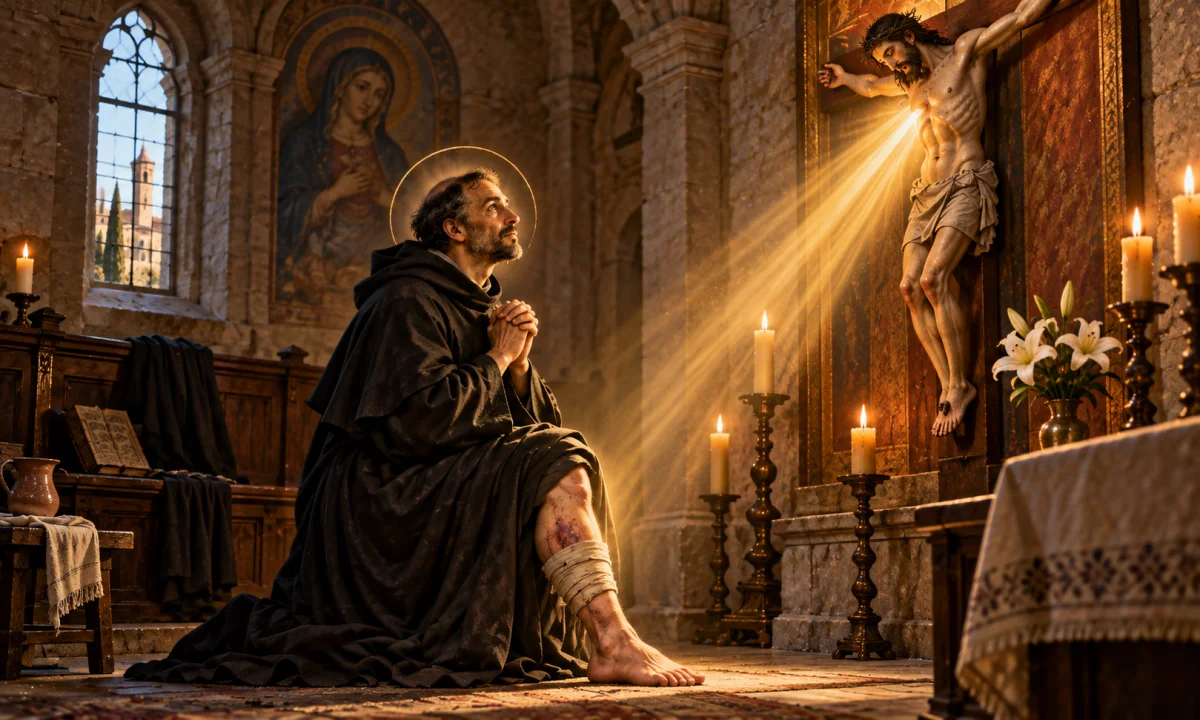
Unlike saints with rich iconographic traditions, Rumon does not have a widely standardized visual profile. There is no universally accepted set of attributes that instantly identify him in art. Where he is represented, later church contexts may present him in the manner of a bishop, monk or local saint, but these depictions are not consistent enough to be treated as traditional iconography in the same way as more prominent saints.
His symbolism is therefore more local and institutional than visual. He represents:
- the sanctity of early medieval western Britain;
- the endurance of local memory in the absence of detailed records;
- the prestige of Tavistock’s ecclesiastical past;
- the blending of history and legend in saintly tradition.
As with many regional saints, the main “attributes” attached to Rumon are not objects in hand but places, names and commemorative practices. A saint can be symbolized by a church dedication as effectively as by a painted halo or carved emblem.
Stories and legendary elements
Specific narrative episodes about St. Rumon are limited and often difficult to verify. Some later traditions may give him a saintly biography in broad terms, but these accounts should be treated with care. Early British saints are frequently surrounded by stories that explain their holiness, connect them to monastic foundations or align them with familiar patterns of piety. Rumon is no exception.
Because the tradition is sparse, it is difficult to distinguish the oldest remembered material from later embellishment. That uncertainty is not unusual. Medieval hagiography often shaped a saint’s life around a few secure facts, local associations and theological themes. The result was a meaningful devotional figure even when historical detail remained thin.
Where legends are preserved, they usually reinforce familiar saintly themes: retreat from ordinary society, devotion to God, spiritual authority, and a continuing presence in the land through sacred memory. Yet there is no reason to claim a large body of miracles or dramatic exploits for Rumon unless a specific source securely supports them. The surviving tradition is more modest than that of major international saints.
Interpretation by historians and scholars
Scholars generally approach Rumon as part of the broad and complex phenomenon of early British local sanctity. In this field, the distinction between history and memory is crucial. A saint may be genuinely ancient and locally revered even if the surviving evidence no longer allows a firm reconstruction of the life. Rumon fits that pattern well.
One plausible interpretation is that he represents an early ecclesiastical figure whose memory was preserved by the monastery at Tavistock and later surrounded by devotional elaboration. Another possibility is that the saintly identity attached to the site developed gradually, with the name and cult becoming fixed over time. The evidence does not permit certainty between these possibilities.
What can be said more confidently is that Rumon belongs to a class of saints important for regional Christianity. They helped create sacred geographies in which monasteries, towns and churches were imagined as heirs to a holy past. Such saints were often less prominent in universal church history than in local identity, yet their cultural role was substantial.
His cult also shows how medieval Christians related holiness to landscape. A saint attached to a particular place made that place spiritually legible. Tavistock was not merely a settlement; it was a site with remembered sanctity. That meaning persisted through changing political and religious circumstances.
Distinction from similar figures
Confusion can arise because medieval saint traditions often contain similar names and overlapping regional associations. Rumon should not be conflated with:
- Rumwold, another saintly name appearing in English tradition, associated with a quite different story;
- other west-country saints whose cults developed in Devon, Cornwall or Brittany;
- later local holy men whose names are similar in spelling but unrelated in tradition.
This distinction matters because saintly traditions were often copied, abbreviated or altered in later manuscripts. A careless reading can easily merge separate cults. In the case of Rumon, the Tavistock association is the key identifying feature, and that should remain distinct from other saints with comparable names.
It is also important not to treat him as a fully documented bishop unless the specific source being followed clearly says so. Some saints acquire episcopal titles in later retellings because the title feels appropriate to sanctity, but that does not automatically prove historical office. The safer stance is to acknowledge that rank and biography are uncertain.
Later memory and reception
Rumon’s later importance lies mainly in antiquarian interest, local devotion and the preservation of Tavistock’s religious heritage. As medieval monastic life changed and many old cults faded, some saints survived more in memory than in active liturgy. Rumon appears to belong to that category. His name remained part of the town’s sacred history even as wider devotion to local saints became less central in post-medieval Christianity.
In modern times, such figures attract interest from historians, local heritage projects and readers curious about Britain’s lesser-known saints. This renewed attention is not the same as an unbroken devotional cult, but it does show that saintly memory can persist in new forms. For Rumon, modern interest is mainly historical and regional rather than popular or global.
He has not entered mainstream modern popular culture in any major way, and there is no widely known body of novels, films or games built around him. That absence is itself revealing: some saints become internationally famous, while others remain rooted in the devotional geography of a single town or monastery. Rumon belongs firmly to the latter group.
Why St. Rumon matters
Rumon matters because he illustrates how Christian sainthood worked in local medieval societies. Not every saint was a universally celebrated figure with a detailed life and extensive iconography. Some were preserved by a single community, a monastery, or a region that valued its own sacred past. Their importance lies in the way they connected people, place and memory.
He also shows how carefully religious history must be handled. Where evidence is limited, it is better to say so than to smooth over uncertainty with invented detail. Rumon’s tradition is meaningful precisely because it is fragmentary: a name, a place, a cult, a memory of holiness at Tavistock. That modest body of evidence is enough to place him within the living landscape of Christian saints in Britain.
Key points of the tradition
- St. Rumon is a local saint associated especially with Tavistock in Devon.
- His historical identity is uncertain, and the surviving record is limited.
- He belongs to the tradition of early British and Celtic regional saints.
- Sources vary on his exact status, and some details are later or uncertain.
- His significance lies in local religious memory, not in a large international cult.
In the religious history of southwest Britain, St. Rumon remains a reminder that sanctity was often preserved in place, name and devotion long after the full story was lost.