WORLD
WORLD
St. Rose Of Viterbo

St. Rose of Viterbo is a young Italian Christian saint remembered for her intense piety, public preaching, and defiance of political power in the thirteenth century. In Catholic tradition she stands as a teenage lay penitent associated with Viterbo, in central Italy, and with the Franciscan spiritual world that shaped much popular devotion in her region. Her cult belongs to the history of medieval sainthood rather than to folklore in the usual sense, though her life was quickly surrounded by devotional memory, local pride, and later hagiographic elaboration.
Rose is usually presented as a virgin martyr in a broad devotional sense, although she was not executed. She died very young, around the age of eighteen, and was revered because of her holiness, ascetic discipline, and courageous public witness. Her feast day is commonly observed on 4 September in the Roman Catholic calendar. Because several episodes in her life come from later devotional tradition rather than from contemporary documentation, historians distinguish carefully between the secure outline of her life and the more embellished elements of her legend.
Historical setting and early sources
Rose lived in Viterbo during the thirteenth century, a period when central Italy was marked by conflict between papal and imperial forces, local factionalism, and strong movements of lay devotion. Viterbo itself was an important papal city at times, and religious enthusiasm was shaped by the presence of new mendicant orders, especially the Franciscans. Rose’s memory developed in that environment, where youthful sanctity, public penance, and prophetic preaching were highly valued.
The surviving tradition about her comes primarily from hagiographic sources rather than from records produced during her lifetime. That means the basic outline of her existence is generally accepted, while many details are difficult to verify independently. Medieval and later accounts emphasize her extraordinary devotion from childhood, her strict fasting, and her habit of exhorting others to conversion. These features are common in saints’ lives and reflect the ideals of the communities that preserved her memory.
Her family background is usually described as humble and devout. She is associated with Viterbo by birth and upbringing, and her identity is strongly tied to that city. Unlike some saints whose cult spread widely through major ecclesiastical offices, Rose’s cult arose first from local devotion and only later became more broadly recognized within the Catholic Church.
Name, identity, and classification
Her name appears in English as Rose of Viterbo, and in Italian as Rosa da Viterbo. The name “Rose” is important symbolically, since roses often suggest purity, beauty, spiritual fragrance, and martyr-like devotion in Christian imagery. In Rose’s case, the name also fits the way later tradition interpreted her as a flower of sanctity blossoming in a troubled city.
She is classed as a Christian saint, specifically a Catholic saint, and is often described as a virgin saint and a lay saint. She was not a nun and did not belong to a formal religious order, though she was closely associated in spirit with the Franciscan movement. That distinction matters: her sanctity was understood to have developed outside the cloister, in ordinary civic life, through preaching, prayer, fasting, and moral courage.
In popular piety, saints like Rose are often remembered through a small set of recognizable traits rather than through a fully documented biography. For Rose these traits include youth, purity, severity toward sin, and bold speech against injustice. Those features are central to her cult and help explain why she was admired both as a religious example and as a symbol of local identity.
Life and traditional account
According to tradition, Rose began showing signs of unusual devotion while still very young. She is said to have taken a strong interest in prayer, penance, and the moral reform of those around her. Medieval saints’ lives often portray such childhood holiness as a sign of divine election, and Rose’s story follows that pattern.
One of the best-known elements in her tradition is her public preaching. She is remembered as a girl who spoke in the streets and squares of Viterbo, urging repentance and defending the Church. This aspect of her life is remarkable because it places a young laywoman in a public religious role normally reserved for ordained clerics. In the devotional imagination of the period, this did not necessarily appear improper; rather, it confirmed the extraordinary nature of her sanctity.
Rose’s preaching was linked to the political tensions of her city. Tradition says that she supported the papal cause against the imperial faction associated with Emperor Frederick II. Whether every detail of this political witness can be verified is uncertain, but the broader picture is plausible in the context of thirteenth-century Italy, where civic loyalties and religious loyalties often overlapped. Her courage in this setting became part of her sanctified memory.
Another recurring theme is her asceticism. She is said to have practiced severe fasting and mortification. Such practices were common markers of holiness in medieval Christian culture, especially for female saints whose bodies were understood as sites of spiritual struggle. Modern readers should note that hagiographic accounts frequently magnify these practices to make spiritual meaning visible. The historical core may be simpler than the later devotional presentation, but ascetic discipline was clearly central to her reputation.
Rose is also associated with rejection of marriage. Some accounts say that she was desired in marriage or was expected to marry, but that she preferred a life of virgin dedication to God. In the hagiographic tradition, her resistance to marriage signals her complete spiritual belonging to Christ. This motif is widespread in Christian saint literature and should not be read as a mere romantic anecdote; it expresses a religious ideal about consecrated virginity.
Expulsion and exile
The most dramatic and best-known episode in Rose’s legend is her expulsion from Viterbo. Tradition says that her outspoken preaching and political opposition angered local authorities, leading to her banishment from the city. She is then remembered as having continued her witness in exile, still encouraging repentance and fidelity.
This story is significant because it turns Rose into a figure of rejection and steadfastness. She becomes not only a moral exhorter but also someone whose sanctity is proven through suffering and exclusion. In Christian hagiography, exile often functions as a sign of prophetic authenticity: the saint speaks truth and is driven out by those unwilling to hear it. Whether the exact circumstances were as dramatic as later accounts suggest, the tradition clearly uses exile to frame her as a faithful witness.
After her expulsion, she is said to have hoped for reconciliation with her hometown. Some versions of the tradition describe her as being allowed to return when political circumstances changed. This element reinforces her bond with Viterbo and explains why the city later embraced her as a local patron and spiritual symbol.
Death and veneration
Rose died young, generally said to have been around eighteen years old. Her early death contributed powerfully to her sanctity, since medieval devotion often viewed an untimely but holy death as confirmation of divine favor. She was buried in Viterbo, and her tomb became an object of local veneration.
After her death, her cult grew through reports of miracles and continued devotion at her burial place. As with many saints, the spread of her reputation was not based on a single dramatic event alone but on the accumulation of memory, liturgical observance, and local testimony. Her body and relics became associated with the presence of holiness, though the details of relic translation and preservation are matters best handled cautiously because later accounts can differ.
She was eventually canonized by Pope Callixtus III in 1457, a formal recognition that marked the maturity of a cult long honored in Viterbo and beyond. Canonization did not create her reputation from nothing; rather, it confirmed and regulated an already established devotion. The long gap between her death and canonization is typical of many medieval saints whose sanctity was first recognized locally.
Symbols, attributes, and visual representation
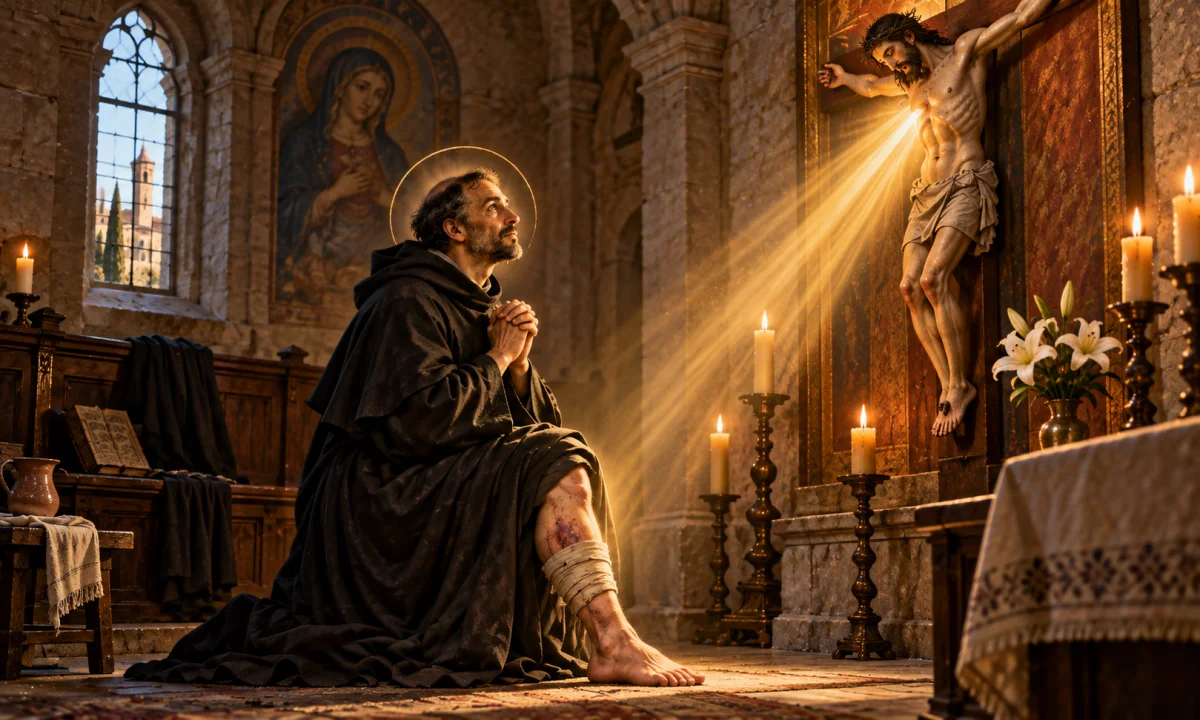
In Christian art and devotional imagery, Rose is often shown as a young girl or maiden, sometimes dressed in simple garments that emphasize humility. Because she is a saint of purity and youth, artists commonly present her with serene features rather than with the dramatic features of a martyr scene. Her imagery may include a rosary, a cross, or lilies, though depictions vary and not every attribute appears consistently.
The rose itself is a natural symbol attached to her name, but it should not be assumed that every image of her includes an actual rose blossom. In saint iconography, the name often carries symbolic weight even when not displayed visually. Roses in Christian tradition can signify virginity, heavenly beauty, and spiritual fragrance, all of which suit Rose’s devotional profile.
Because she was remembered as a preacher, some representations may allude to her speaking role or to her courageous public witness. Yet she is not as universally associated with a single standardized iconographic attribute as some saints are. That lack of strict uniformity reflects the local and devotional character of her cult.
Spiritual meaning and religious interpretation
Rose of Viterbo is important in Christian tradition as an example of holiness expressed through youth, lay status, and public courage. She demonstrates that sanctity was not limited to monks, priests, or elderly ascetics. Her life was remembered as a challenge to the assumption that religious authority belongs only to formal office. In this way she belongs to a larger medieval pattern in which holy women, especially young women, could be portrayed as divinely authorized voices of correction.
Her story also reflects the medieval valuation of chastity, penance, and orthodoxy. These qualities may seem unfamiliar to modern readers, but within her tradition they were not merely private virtues. They were signs of ordered love, loyalty to the Church, and resistance to corruption or injustice. Her public witness suggests that holiness had civic consequences, not only personal ones.
At the same time, modern scholarship tends to read her legend with caution. Hagiography often compresses events, dramatizes conflicts, and uses symbolic storytelling to express theological truths. That does not make the tradition meaningless; it means that Rose’s historical life and her saintly image are related but not identical. Her lasting importance lies partly in that very relationship, where a historical young woman became a model of spiritual resolve.
Relations with the Franciscans and medieval piety
Rose is often linked with the Franciscan world, though she was not herself a Franciscan nun. This association reflects the broader influence of Franciscan spirituality in thirteenth-century Italy, especially its emphasis on poverty, repentance, humility, and preaching. Her devotion resonated strongly with those ideals.
Franciscan influence also helps explain why Rose was remembered as a young lay preacher. The mendicant movements encouraged new forms of popular religious speech and moral reform. While ordained preaching remained regulated, the devotional culture around these movements was fertile ground for stories of charismatic lay holiness. Rose fit naturally into that environment.
Her cult thus reveals something about the religious imagination of medieval Italian cities. Civic identity, penitential spirituality, and papal loyalty could all be woven together in the memory of a single saint. Rose became a figure through whom Viterbo could express both local pride and Christian virtue.
Distinguishing her from similar figures
Rose of Viterbo should not be confused with other saints or holy women named Rose, especially St. Rose of Lima, the later Peruvian saint, or with different local devotional figures sometimes called Rosa or Rosina. The best-known Rose in the wider Catholic world today is Rose of Lima, but the two saints belong to very different eras, cultures, and spiritual settings. Rose of Viterbo is medieval Italian; Rose of Lima is early modern and Latin American.
Nor should she be merged with romanticized “rose” symbolism in general Christian art. The flower imagery associated with her name is meaningful, but it does not replace the specific historical and devotional identity attached to Viterbo. Her cult is local in origin, medieval in setting, and strongly shaped by the politics and piety of central Italy.
Later reception and continuing devotion
Rose remained significant in Viterbo after the Middle Ages, where she continued to be honored as a city saint and a model of youthful faith. Her memory survives in churches, liturgical observances, and local devotion. Such cults often endure because they connect sacred history with place: a saint is not only admired abstractly but remembered as belonging to a community.
In modern Catholic devotion, Rose of Viterbo is often invoked as a patron of youth, of the Franciscans, and of those who seek courage in public witness. Her story appeals to believers who value simplicity and moral firmness. She also resonates with those interested in women’s religious history, since she represents a form of sanctity that operated outside formal clerical structures.
Modern popular culture has not produced a large body of worldwide adaptations centered on her, and she is far less visible than some other saints in literature, film, or mass media. Where she does appear, it is usually in devotional, local, or ecclesiastical contexts rather than in broad popular entertainment. Her importance remains primarily religious and historical rather than commercial.
Why she remains significant
Rose of Viterbo endures as a saint whose life combines youth, intensity, and civic witness. Her tradition speaks to the medieval Christian belief that holiness can interrupt ordinary social expectations. A girl could preach; a layperson could become a moral authority; a local city could remember a young exile as a saintly protector. Those are the enduring themes of her cult.
Her place in Christian tradition is therefore not only as a pious maiden but also as a symbol of courageous speech and unwavering devotion. Even where historical certainty is limited, the shape of her memory is clear: she was revered as someone who chose fidelity to God over social comfort, and who turned personal sanctity into a public act.
Common themes in her tradition
- Youthful holiness and virgin dedication
- Lay preaching and public exhortation
- Opposition to political injustice in thirteenth-century Italy
- Exile and later reconciliation with her city
- Association with Franciscan spirituality
- Local devotion in Viterbo and canonization in the fifteenth century