WORLD
WORLD
St. Prætextatus
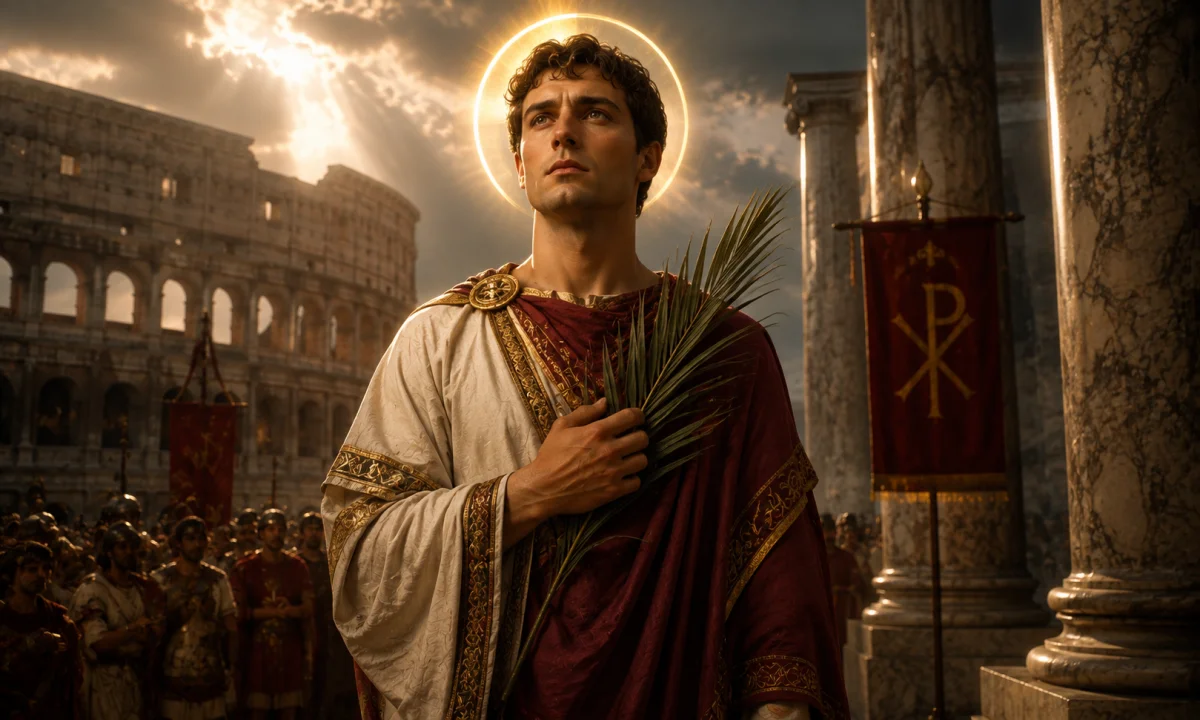
St. Prætextatus, also written Praetextatus, Pretextatus, or Prétextat, was a sixth-century bishop of Rouen in northern Gaul. He is remembered in Christian tradition as a bishop, political victim, and martyr whose death was connected with the violent succession struggles of the Merovingian royal family. His life is especially important because it appears in the historical narrative of Gregory of Tours, while later ecclesiastical traditions developed his reputation as a courageous defender of episcopal independence.
Identity and historical setting
Prætextatus belonged to the world of Merovingian Gaul, the Christian kingdom ruled by the descendants of Clovis during the sixth century. This was a period in which bishops were not only religious leaders. They also acted as judges, diplomats, patrons of the poor, administrators of urban communities, and influential figures at royal courts. Their authority could bring them into direct conflict with kings and queens.
Rouen was an important city in the northern part of the Frankish realms. Its bishop occupied a position of considerable social and political influence. Prætextatus appears to have held the see of Rouen from approximately the middle of the sixth century until his death, although the exact beginning of his episcopate is not entirely secure. Medieval lists and later church traditions preserve his name among the bishops of Rouen, but they do not provide a complete biography.
The main near-contemporary account of his career is found in the History of the Franks by Gregory of Tours. Gregory was himself a bishop and wrote about the conflicts among the Merovingian rulers and their bishops. His account is both a historical narrative and a Christian interpretation of events, so it should be read as evidence shaped by ecclesiastical concerns rather than as a neutral modern biography.
The name Prætextatus
The Latin form Praetextatus is the source of the English form Prætextatus and the French form Prétextat. Spellings vary because the saint's name passed through Latin manuscripts, medieval French usage, and modern forms of transcription. The name should not be confused with similarly spelled names such as Pretextus or Praetextus, which may refer to different people.
The name itself is Roman in form. It is related to praetexta, the bordered garment associated with Roman magistrates and certain religious offices. That linguistic background does not establish that the bishop's family had any particular connection with Roman official culture. By the sixth century, Roman names remained common among Christian communities in Gaul, and the name alone reveals little about Prætextatus's ancestry.
Prætextatus and the Merovingian court
Prætextatus became involved in a major dynastic conflict through the marriage of Merovech, the son of King Chilperic I, to Brunhilda. Brunhilda was the widow of Merovech's uncle, King Sigebert I. The marriage therefore had serious political implications, since it joined members of rival branches of the Merovingian dynasty.
The marriage was celebrated at Rouen in the late sixth century, probably in 576. Prætextatus was associated with the ceremony and was subsequently accused by Chilperic of encouraging Merovech's opposition to his father. The king also accused the bishop of using wealth and gifts to build a political alliance against him. These accusations took place within a broader struggle involving royal succession, rival queens, aristocratic factions, and competing Frankish kingdoms.
In 577, Prætextatus was brought before a church council held at Paris. The proceedings were presented as an ecclesiastical judgment, but royal pressure was plainly involved. Gregory of Tours describes the council as deeply compromised by the king's demands. Prætextatus defended himself and rejected the accusations, while the king sought a condemnation that would remove the bishop from his position.
The bishop was condemned and sent into exile. Gregory's account treats Prætextatus sympathetically and portrays the trial as an example of secular power manipulating church courts. Gregory also presents himself as willing to challenge the king during the proceedings. This episode illustrates a recurring theme in early medieval Christian history: bishops could be powerful members of the ruling order, yet they could also claim a religious authority that placed limits on royal commands.
Exile and restoration
The details of Prætextatus's exile are not consistently preserved. Later accounts give additional information, but these traditions are difficult to separate from the literary patterns commonly used in the lives of saints. What is historically clear is that he was removed from Rouen after the council and that his position was later restored.
King Chilperic was assassinated in 584. After the change in political circumstances, Prætextatus returned to Rouen and resumed his episcopal office. His restoration did not end the danger surrounding him. The bishop had survived a royal prosecution, and his return represented both a personal vindication and a potential challenge to the authority of Queen Fredegund, Chilperic's widow and one of the most powerful figures in the Merovingian struggle.
According to Gregory of Tours, Prætextatus spoke openly against the wrongdoing associated with the court. Gregory presents Fredegund as fearing that the restored bishop would act against her or expose her actions. The queen therefore became connected in both historical and hagiographical tradition with the plot against him. The precise sequence of events and the degree of her personal responsibility remain matters of historical interpretation, although the traditional account strongly attributes the assassination to her initiative.
Death and martyrdom
Prætextatus was attacked in his church at Rouen and died from his wounds. The traditional date is 24 February 586, although medieval calendars and modern references do not always agree on the exact date. Some accounts emphasize that he was praying in the church when the assassin struck him. This setting became important to his later image: he was not remembered merely as a bishop killed in a political dispute, but as a Christian shepherd murdered within his own sacred community.
The identity of the immediate killer is not consistently emphasized in later summaries. Gregory of Tours describes the attack as part of a plot connected with Fredegund, while later hagiographic traditions focus more on the bishop's patient endurance and readiness to forgive. These accounts should not be treated as equally strong historical evidence. The political context and the fact of his violent death are better supported than the detailed speeches, gestures, or private motives attributed to him by later writers.
Prætextatus's death is regarded as martyrdom because he was killed in circumstances linked to his ecclesiastical office and his opposition to royal injustice. In Christian terms, martyrdom does not require death during a formal persecution directed against all Christians. A bishop murdered because he defended his religious responsibilities or resisted a corrupt ruler could also be understood as a martyr and confessor of the faith.
Religious meaning and symbolism
Prætextatus represents several connected ideals in western Christian tradition:
- Episcopal courage: he is remembered as a bishop who did not simply accept a politically forced condemnation.
- Resistance to injustice: his conflict with the Merovingian court became an example of the moral limits of royal authority.
- Pastoral fidelity: his death in or near his church links his martyrdom with his responsibility for the Christian community of Rouen.
- Forgiveness under persecution: later devotional traditions portray him as meeting violence with Christian patience rather than revenge.
- The danger of court politics: his story reflects the instability of a society in which family rivalry, royal power, and ecclesiastical office were closely entangled.
There is no single universally fixed set of miraculous powers or supernatural attributes associated with Prætextatus. Traditional images of him generally follow the visual language used for bishops and martyrs: ecclesiastical clothing, a pastoral staff, and sometimes a martyr's palm. These are conventional signs of office and sainthood rather than details independently established by early historical evidence. A weapon or wound may appear in some representations to indicate his violent death, but artistic treatment varies by region and period.
Sources and the development of his cult
Gregory of Tours is the central early witness for Prætextatus's conflict with Chilperic and his subsequent murder. Gregory's narrative places the bishop within the real political disputes of sixth-century Gaul and gives the story unusual historical value. At the same time, Gregory writes with clear moral purposes. He contrasts bishops who defend truth with rulers who use violence, and he interprets political events through Christian ideas of sin, judgment, and providence.
Later liturgical texts, episcopal lists, saints' lives, and local traditions expanded Prætextatus's memory. Such materials helped establish him as a patronal saint of Rouen and as a model of episcopal steadfastness. They may preserve local memories that are not found in Gregory, but they also contain conventional elements of medieval hagiography, including idealized speeches, dramatic confrontations, and signs of divine favor.
His cult was particularly connected with Rouen and the ecclesiastical history of Normandy. The survival of his name in local religious commemorations reflects the importance of early bishops in the identity of medieval cities. A bishop who had suffered exile and assassination could be remembered as a protector of the church's dignity, especially during later periods when church communities were negotiating their relationship with secular rulers.
Feast day and local observance
Prætextatus is commonly commemorated on 24 February. Calendar traditions can vary, particularly where local liturgical use differs from the Roman Martyrology or where feast days are adjusted to avoid conflicts with other celebrations. The form of his name may also change according to the language of the calendar: English sources often use Praetextatus, while French sources usually use Prétextat.
His commemoration belongs to the tradition of honoring early bishops of Gaul as foundational figures in the Christian history of particular cities. It should not be assumed that every local practice associated with Rouen has survived continuously from the sixth century. Medieval cults could be interrupted, relocated, or reshaped by changes in church administration, warfare, reform, and the movement of relics.
Distinction from other figures named Praetextatus
The name Praetextatus appears in more than one historical and religious context. It was a Roman personal name, and ancient records mention non-Christian Romans who bore it. Those individuals are not the bishop of Rouen. Christian calendars may also preserve other martyrs or saints with closely related forms of the name. A reference to “Saint Praetextatus” without a city, date, or ecclesiastical title can therefore be ambiguous.
The figure associated with the Merovingian court, the bishopric of Rouen, exile under Chilperic, and assassination after his restoration is Prætextatus of Rouen. He should also be distinguished from saints whose names are rendered in English as Pretextus, Praetextus, or similar variants. Similar spelling does not demonstrate shared identity, shared cult, or a family relationship.
Later reception
Prætextatus has not become a major figure in modern popular culture, and he has no widely established presence in film, fantasy literature, or mass-market religious media. His continuing significance is primarily historical and devotional. He is studied as a witness to the relationship between bishops and rulers in Merovingian Gaul, and he remains part of the Christian memory of Rouen.
Modern interpretations often emphasize the political character of his story. Rather than presenting him only as a passive victim, historians examine how episcopal authority operated within royal government, how church councils could be influenced by monarchs, and how Gregory of Tours shaped the image of a bishop confronting tyranny. Religious devotion, meanwhile, continues to understand him as a martyr whose fidelity to his office mattered more than personal safety.