WORLD
WORLD
St. Philip
Saint Philip is traditionally remembered as one of the Twelve Apostles of Jesus Christ. He appears especially in the Gospel of John, where he brings Nathanael to Jesus, participates in the feeding of the multitude, and asks Jesus to show the disciples the Father. Christian tradition honours him as a missionary and martyr, although later accounts of his life contain legendary material and are not always consistent. He must also be distinguished from another early Christian named Philip, the evangelist and one of the Seven chosen in Jerusalem.
Identity and name
The name Philip comes from the Greek Philippos, meaning “lover of horses” or “friend of horses.” It was a common Greek name in the eastern Mediterranean, including among people living under the influence of Hellenistic culture. The use of a Greek name does not by itself show that Philip was ethnically Greek. He was a Jewish man from Galilee and a follower of Jesus within the setting of first-century Jewish religious life.
The Gospel of John identifies Philip as being from Bethsaida, the same town associated with the apostles Peter and Andrew. In the Synoptic Gospels—Matthew, Mark and Luke—Philip is listed among the Twelve, but he is not given a major individual role. John provides most of the information about his personal encounters with Jesus.
Several people named Philip appear in the New Testament and later Christian history. The most important distinction is between:
- Philip the Apostle, one of the Twelve disciples of Jesus.
- Philip the Evangelist, one of the Seven appointed to serve the Jerusalem Christian community and a missionary described in the Acts of the Apostles.
- Other historical figures named Philip, including members of ruling dynasties who are not Christian saints.
Some later traditions treated the Apostle and the Evangelist as the same person, but many modern scholars regard them as distinct figures because the New Testament presents them in different contexts and gives them different descriptions.
Philip in the New Testament
In the Gospel of John, Jesus finds Philip and says, “Follow me.” Philip then finds Nathanael and tells him that they have found the one spoken of by Moses and the prophets: Jesus of Nazareth, the son of Joseph. Nathanael initially questions whether anything good can come from Nazareth, but Philip responds by inviting him to “come and see.” This short exchange has made Philip a symbol of personal invitation and practical evangelism. Rather than trying to win an argument, he brings Nathanael into direct contact with Jesus.
Philip also appears in the account of the feeding of the five thousand. Jesus asks him where bread can be bought for the crowd. The question tests Philip, who calculates that even a large amount of money would not provide enough food for everyone. The Gospel then describes the use of five barley loaves and two fish, followed by the miraculous feeding.
In another episode, some Greek-speaking visitors who have come to Jerusalem for the festival approach Philip and ask to see Jesus. Philip tells Andrew, and together they bring the request to Jesus. The passage gives Philip a significant intermediary role. His Greek name and connection with Bethsaida may have made him a natural contact for Greek-speaking visitors, although the text does not explicitly explain why they approached him.
Philip’s final prominent appearance in John occurs during the Last Supper. When Jesus speaks of knowing the Father, Philip asks him to show the disciples the Father, saying that this would be enough for them. Jesus answers by teaching about the relationship between himself and the Father. Christian interpretation has often viewed Philip’s question as sincere but limited: he desires a direct vision of God, while Jesus directs the disciples toward recognising God through him.
The Gospel accounts do not describe Philip’s later missionary journeys or death. The Acts of the Apostles includes Philip the Evangelist, but it does not explicitly identify that man with Philip the Apostle. This absence of a detailed apostolic biography left room for later communities to preserve and develop traditions about Philip.
Philip and the other early Christian Philip
Philip the Evangelist first appears in Acts as one of seven men chosen to help oversee the distribution of food to widows in the Jerusalem community. He is not called one of the Twelve. Later, he preaches in Samaria, where he performs signs and attracts many converts. He also explains the Christian message to an Ethiopian official travelling home from Jerusalem. After baptising him, Philip is described as being carried away by the Spirit and later appears in the coastal city of Azotus.
Acts eventually places Philip in Caesarea, where he is called “the evangelist.” He has four unmarried daughters who prophesy. These details belong to a figure who had an active missionary ministry after the persecution of the Jerusalem church. Because both men bore the same name and were associated with early Christian preaching, later writers sometimes merged their biographies.
The distinction matters because claims about Philip’s travels, preaching and family cannot automatically be assigned to the Apostle. The New Testament clearly gives the Apostle a place among the Twelve, while it gives the Evangelist a prominent role in Acts. The two may have been the same person, but the surviving texts do not establish that identification.
Later traditions about the Apostle
After the New Testament period, Christian communities preserved traditions about Philip’s missionary work in regions such as Phrygia, a territory in central and western Anatolia. The city of Hierapolis is especially associated with him in later accounts. Some traditions connect him with Bartholomew and with a woman named Mariamne, who may be presented as his sister or companion in missionary work. These relationships are not established by the New Testament and vary among sources.
Accounts of Philip’s death also differ. In one widespread tradition, he was crucified or suspended on a cross at Hierapolis. Other accounts say that he was killed by stoning, sometimes after being crucified. The variation may reflect the development of local traditions rather than reliable historical reporting. The date of his death is not known.
An early Christian work known as the Acts of Philip contains a much fuller and more dramatic narrative. It presents Philip as a wonder-working missionary who confronts pagan religion, heals the sick, casts out demons and challenges oppressive powers. The surviving form of the work is generally considered later than the apostolic period and contains legendary episodes, theological symbolism and literary elaboration. It is valuable as evidence for how some Christians imagined apostolic mission, but it should not be treated as a straightforward biography.
The traditions associated with Hierapolis also became connected with the memory of other apostles and missionaries. Because different local churches preserved competing claims about apostolic preaching and martyrdom, details such as the place of death, companions and method of execution should be presented as traditional rather than certain historical facts.
Role and symbolism
Philip’s New Testament character is defined less by speeches or independent achievements than by the way he directs people toward Jesus. His introduction of Nathanael illustrates the role of the witness who receives a claim, shares it with another person and invites that person to investigate. His contact with the Greek visitors similarly portrays him as a bridge between Jesus and outsiders or visitors from beyond the immediate circle of disciples.
His question at the Last Supper has given him a second symbolic role. Philip represents the human desire for visible certainty and direct knowledge of God. In Christian preaching and theology, his request can be interpreted both as an expression of faith and as an example of incomplete understanding. The apostle is not portrayed as a villain or traitor; he is a sincere disciple whose questions reveal the difficulty of grasping Jesus’ teaching.
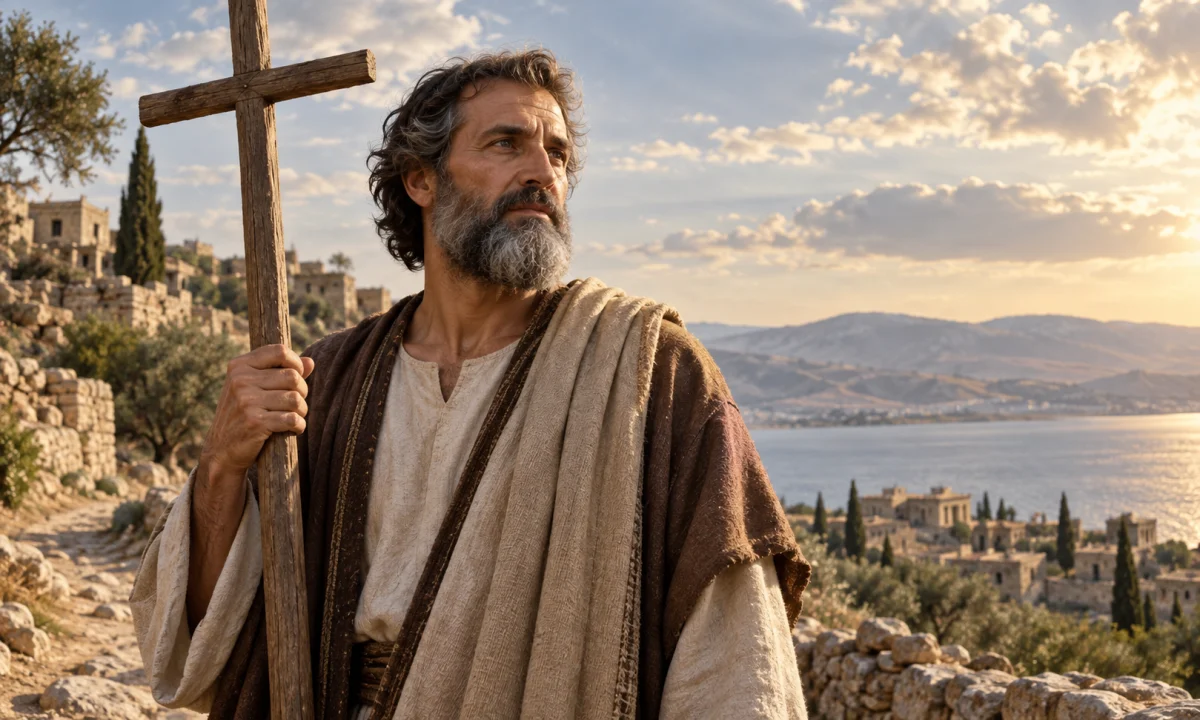
Artists commonly portray Philip as an older bearded apostle holding a book, scroll or cross. The book refers to his role as a preacher of the Gospel, while the cross recalls the tradition of his martyrdom. In some works, he carries a cross-shaped staff or stands beside a cross. These attributes are not descriptions from the New Testament but visual conventions developed in Christian art.
Scenes especially associated with Philip include his calling by Jesus, his meeting with Nathanael, the feeding of the multitude, the approach of the Greek visitors and the request to see the Father. In images of the apostles, he may be identified by an inscription, a cross or his position within the group rather than by a single universally fixed emblem.
Feasts and Christian observance
Philip’s feast is observed on different dates in different Christian traditions. In the Roman Catholic calendar, Philip is celebrated together with Saint James the Less on 3 May. This joint feast reflects the liturgical commemoration of two apostles whose relic traditions and later identities became associated with the church of the Apostles at Rome.
Many Eastern Orthodox churches celebrate the Apostle Philip on 14 November. His feast marks the beginning of the traditional Nativity Fast, the period of preparation for Christmas in the Byzantine tradition. Because the liturgical calendars of Eastern and Western churches developed separately, the difference in dates is not an indication that different Philips are being commemorated.
Some Oriental Orthodox and other Eastern Christian communities preserve their own calendars, readings and local customs. The wording of prayers and the emphasis placed on Philip may differ, but the central identity remains that of the apostle among the Twelve.
Relics and churches
Several Christian communities have claimed a connection with Philip’s relics. Rome has long been associated with relics attributed to Philip and James in the Basilica of the Twelve Apostles. Hierapolis in modern Turkey remains important in discussions of his traditional martyrdom and apostolic memory. Archaeological discoveries at Hierapolis have strengthened the city’s importance as an early Christian centre, but archaeology alone cannot prove every detail of the later written accounts about Philip.
Relic traditions often express the continuity that a church believes it has with the apostles. They can preserve local memory, support pilgrimage and shape the dedication of churches, even where the historical chain of custody cannot be independently demonstrated. Claims about relics should therefore be distinguished from securely documented events in Philip’s first-century life.
Patronage and cultural significance
Philip is honoured as a patron or secondary patron in various places and professions, although these associations are not uniform across Christianity. Some traditions connect him with cities, regions and groups that claim an apostolic link to his preaching. His name has also been associated in parts of Europe with occupations such as hat-making, but patronage customs vary by country and local devotional practice.
His importance rests primarily on his place among the Twelve and on the brief but memorable episodes preserved in John. He is a model of the disciple who brings another person to Jesus, a representative of those who seek a clearer vision of God and a witness to the missionary identity of the apostolic church. The New Testament presents him as a real participant in the earliest circle of Jesus’ followers, while later traditions expand him into a travelling preacher and martyr.
Distinguishing Philip from similar figures
Philip the Apostle should not be confused with Philip the Evangelist, despite the possibility that some ancient or medieval traditions identified them. Nor should either be confused with Philip the Tetrarch, a first-century ruler mentioned in the New Testament, or with other members of the Herodian dynasty who bore the name Philip. Those political figures belonged to the ruling family of Judaea and Galilee and were not apostles or Christian saints.
There is also no sound basis for treating every story about a missionary named Philip as evidence about the Apostle. The most secure information about Philip the Apostle comes from the lists of the Twelve and the episodes in the Gospel of John. His later journeys, companions, miracles and martyrdom belong to ecclesiastical tradition of varying age and reliability. Keeping these layers separate allows Philip to be understood both as a figure rooted in the earliest Christian writings and as a saint whose memory developed through worship, storytelling, art and local tradition.