WORLD
WORLD
Raum
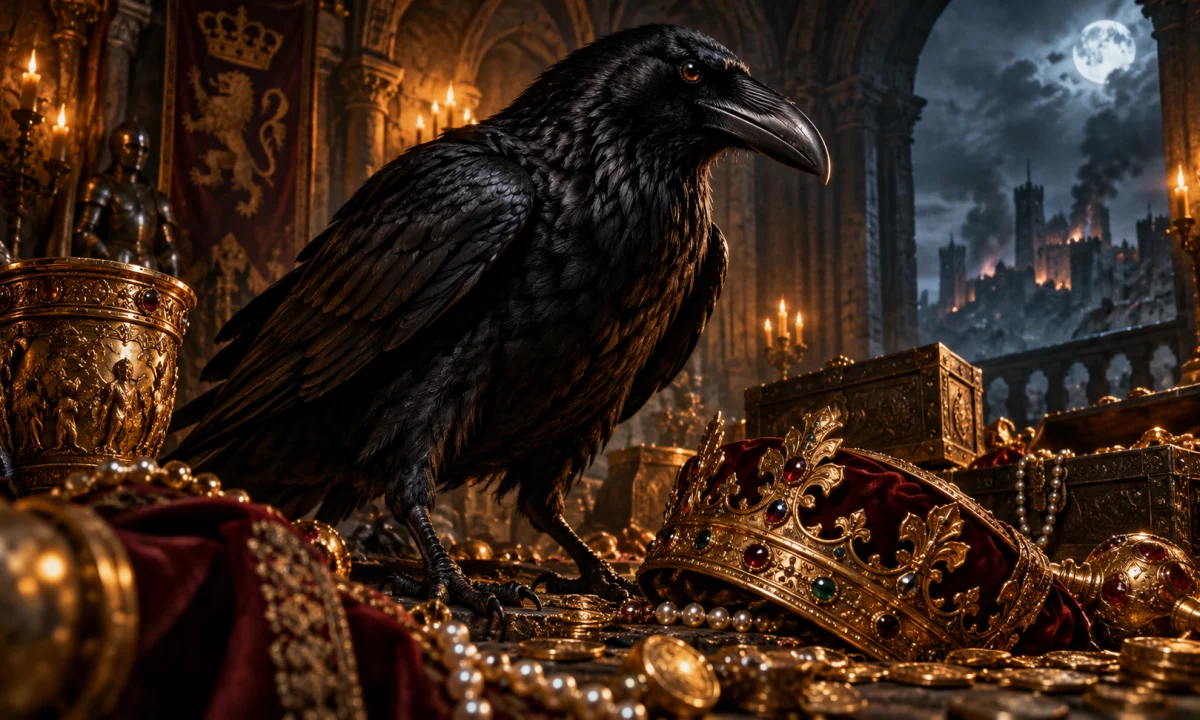
Raum is a demon of European ceremonial magic, best known from the Ars Goetia, the first section of the seventeenth-century grimoire commonly called The Lesser Key of Solomon. In that tradition, Raum is listed as the fortieth spirit and is described as a Great Earl who initially appears in the form of a crow before assuming human shape at the command of the magician. His stated powers concern theft, prophecy, the movement of treasure, and the creation of affection or reconciliation between people.
Raum belongs to a textual tradition of Christian demonology and ritual magic rather than to a clearly documented ancient mythology. The Ars Goetia presents its spirits within a hierarchical system of kings, dukes, princes, marquises, earls and other ranks. These classifications reflect the structure and concerns of early modern magical literature. They should not be treated as evidence that Raum was a widely worshipped deity or a major figure in pre-Christian religion.
Origins in demonological literature
The principal source for Raum is the Ars Goetia. This work gives a catalogue of seventy-two spirits, each with a name, rank, appearance, number of subordinate legions and a description of its supposed powers. The text also supplies a seal associated with each spirit and places the encounters within a ritual framework involving conjuration, command and containment.
The Ars Goetia is part of a larger manuscript tradition rather than an isolated composition. Its material is related to earlier European lists of demons, especially catalogues associated with the sixteenth-century demonological literature of Johann Weyer and other writers. The precise history of every name is not equally clear, and the spelling and details of individual spirits can vary among manuscripts and later editions. Raum is therefore best understood as a figure shaped by the development of learned magical books, not as a securely traceable survival from one ancient religious tradition.
The work attributes its system to Solomon, following a common pattern in magical literature that placed secret knowledge in the hands of a famous biblical king. This attribution is legendary and pseudepigraphal. There is no historical evidence that the biblical Solomon compiled the catalogue of spirits known as the Ars Goetia. The Solomonic setting nevertheless mattered greatly because it gave the ritual magician an imagined authority over spirits through the power of sacred names, divine commands and prescribed ceremonial procedures.
Name, rank and classification
Raum is generally identified as the fortieth spirit in the standard ordering of the Ars Goetia. He is called a Great Earl, a title that places him among the spirits ranked below kings and princes but above lesser officials in the catalogue's invented infernal hierarchy. The text states that he commands thirty legions.
The same entry says that Raum was formerly of the Order of Thrones. This detail reflects a broader habit in Christian demonological writing: demons are sometimes described as fallen or displaced members of an angelic order. The statement does not establish an independent earlier tradition about Raum. It is part of the classification supplied by the grimoire and should be read within its theological and literary framework.
Variations in spelling occur in related magical and demonological material. “Raum” is the most familiar English form because it appears in influential editions of the Ars Goetia. Older texts and modern transcriptions may preserve variant spellings or slightly different descriptions. These differences do not necessarily indicate separate beings, but they make it unwise to assume that every similarly spelled name has exactly the same history.
Appearance and animal symbolism
Raum is said to appear first as a crow. The text then states that he can take human form when commanded by the exorcist or ritual magician. This two-stage appearance is one of the most distinctive features of his entry. The crow form links Raum with a familiar bird associated in European symbolism with carrion, battlefields, death, intelligence and ominous knowledge.
The source does not provide a detailed physical description of the bird. It does not specify its size, colour beyond the normal implications of a crow's appearance, or any particular markings. Later illustrations and occult artwork may give Raum a more dramatic or monstrous form, but those visual additions belong to later interpretation rather than to the short description in the grimoire.
The crow should not automatically be interpreted as proof of a direct connection with a particular ancient bird deity or folkloric raven spirit. Crows and ravens have rich symbolic histories in many cultures, but the Ars Goetia gives no extended myth explaining why Raum takes this form. The bird may function as a sign of cunning, death, movement between places and access to hidden knowledge, yet these are interpretive possibilities rather than explicit statements by the source.
Powers and offices
Raum's listed offices combine material theft with information, prediction and emotional influence. The entry says that he can steal treasures from a king's house and carry them wherever he is commanded. This power fits the social world of aristocratic courts and fortified households that appears throughout European legends and magical texts. Treasure represents wealth and political power, while the ability to remove it from a ruler's house reverses the security normally associated with royal authority.
The description does not present Raum as a general patron of thieves or as a deity of wealth. Instead, it depicts him as an agent who performs a specific act for the magician: taking valuable objects from a powerful person's house and transporting them elsewhere. The wording is part of a catalogue of ritual services and should not be expanded into a broader mythology without evidence.
Raum is also said to reveal things past, present and future. This places him among the spirits associated with divination and concealed knowledge. The formula is common in magical and occult literature, where a spirit's ability to describe events across time establishes its usefulness to the practitioner. The text does not preserve particular prophecies delivered by Raum, nor does it offer stories showing how his predictions operate.
A further power is the ability to cause love between friends and enemies. This wording can be understood as emotional influence, reconciliation or the creation of affection where hostility previously existed. The statement is brief and does not explain whether the result is sincere, temporary, coercive or merely apparent. It is therefore more accurate to say that Raum is credited with producing or encouraging love and concord than to describe him as a benevolent spirit of friendship.
His powers form an interesting contrast. He can deprive rulers of treasure, disclose hidden knowledge and alter relationships. Together, these abilities present him as a spirit of movement and disruption: wealth can be removed from its expected place, information can cross the boundaries of time, and hostility can be transformed into attachment. This pattern is a modern interpretive synthesis, however, rather than a developed narrative in the original catalogue.
Raum in the ritual system
In the Ars Goetia, a spirit's entry is not a myth in the usual sense. It is a compact set of ritual data. The name, rank, visible form, powers, number of legions and seal are intended to support a ceremonial encounter. The magician is expected to summon the spirit through formal procedures and to command it within a religiously framed hierarchy.
These rituals draw on a mixture of biblical language, Christian concepts of demons, astrological and magical symbolism, and inherited traditions of conjuration. The spirits are not normally presented as objects of ordinary devotion. They are treated as subordinate beings who must be compelled, controlled or constrained through divine authority. This is an important distinction between the grimoire's Raum and a god, saint, household spirit or figure honoured in a living religious cult.
The catalogue also reflects the moral perspective of Christian demonology. Activities such as theft, manipulation and the pursuit of forbidden knowledge are placed within a system in which contact with demons is spiritually dangerous. Even when a spirit is assigned a seemingly helpful power, such as reconciling enemies, the ritual context presents that power as something obtained through illicit or hazardous dealings.
Stories, relationships and variants
Raum has no extensive cycle of myths, family relationships or heroic stories in the surviving Goetic description. He is not given a birth, genealogy, spouse, enemy or place of residence. Unlike figures from epic or folklore, he is known primarily through a catalogue entry rather than through a sequence of narrative episodes.
The most important “story” associated with him is therefore the scenario implied by his ritual description: a spirit arrives as a crow, changes into human form when commanded, carries away royal treasure, reports on events across time and affects the bonds between friends and enemies. These actions create a recognizable profile, but they do not amount to a continuous biography.
As with many Goetic names, details may differ between manuscript families, translations and occult editions. Some versions preserve small changes in wording, punctuation or title. Modern writers may also expand the description by assigning additional colours, personalities, astrological correspondences or invented legends. Such additions should be identified as later occult interpretation rather than attributed to the earliest available form of the text.
Interpretation and cultural significance
Raum can be read as an example of how early modern demonological catalogues transformed broad anxieties into specialized supernatural offices. His theft of royal treasure expresses fear of insecurity and the vulnerability of wealth. His knowledge of past, present and future reflects the attraction of forbidden information. His power over friendship and enmity touches on the desire to control relationships that are normally unpredictable.
The bird form adds another layer to this profile. A crow is mobile, observant and associated with places where ordinary social order breaks down. It can move between the human world and landscapes of death without belonging fully to either. In Raum's entry, the crow is not developed into a complete mythic symbol, but it gives the spirit an immediately memorable identity before the more human and administrative language of rank and office takes over.
Raum also illustrates the difference between classification and character in occult catalogues. His title as an earl and his command of thirty legions make him appear like a political official in an infernal court. Yet the text gives very little personality or dialogue. The hierarchy supplies status, while the list of powers supplies practical function. Later readers may imagine Raum as cunning, secretive or aristocratic, but those traits are interpretations based on his rank and offices rather than fully developed attributes in the source.
Distinction from similar figures
Raum should not be confused with every demon or spirit associated with a crow or raven. Many mythological and folkloric traditions contain intelligent birds, prophetic birds or supernatural beings that take avian form. Similar imagery does not establish a direct identity. Raum's defining context is the European Solomonic grimoire tradition and its specific combination of a crow appearance, the rank of Great Earl, thirty legions, theft of royal treasure, prophecy and influence over affection.
He should also be distinguished from demons whose names or titles resemble his in later occult lists. Spellings can shift during copying and translation, and modern databases sometimes merge entries without explaining their textual basis. A name that looks similar is not enough to prove that two spirits are the same. Raum's identification depends on the complete cluster of details preserved in his Goetic entry.
Later reception
Raum has remained relevant mainly within modern occultism, demonology writing and the wider revival of interest in the Ars Goetia. Contemporary practitioners may interpret the spirit psychologically, symbolically or ritually, sometimes treating the crow as a sign of transformation and the theft of treasure as a metaphor for recovering hidden resources. These approaches vary considerably and do not represent a single traditional doctrine.
He also appears occasionally in modern fantasy, role-playing games, fiction, music and visual art inspired by demonological catalogues. Such works may give him a new appearance, personality, mythology or set of abilities. When Raum is adapted in this way, the result belongs to modern popular culture rather than to the historical tradition of the Ars Goetia. The traditional literary profile remains comparatively concise: a Great Earl, first seen as a crow, credited with carrying away treasure, revealing information about time and influencing the relations between friends and enemies.