WORLD
WORLD
Ose
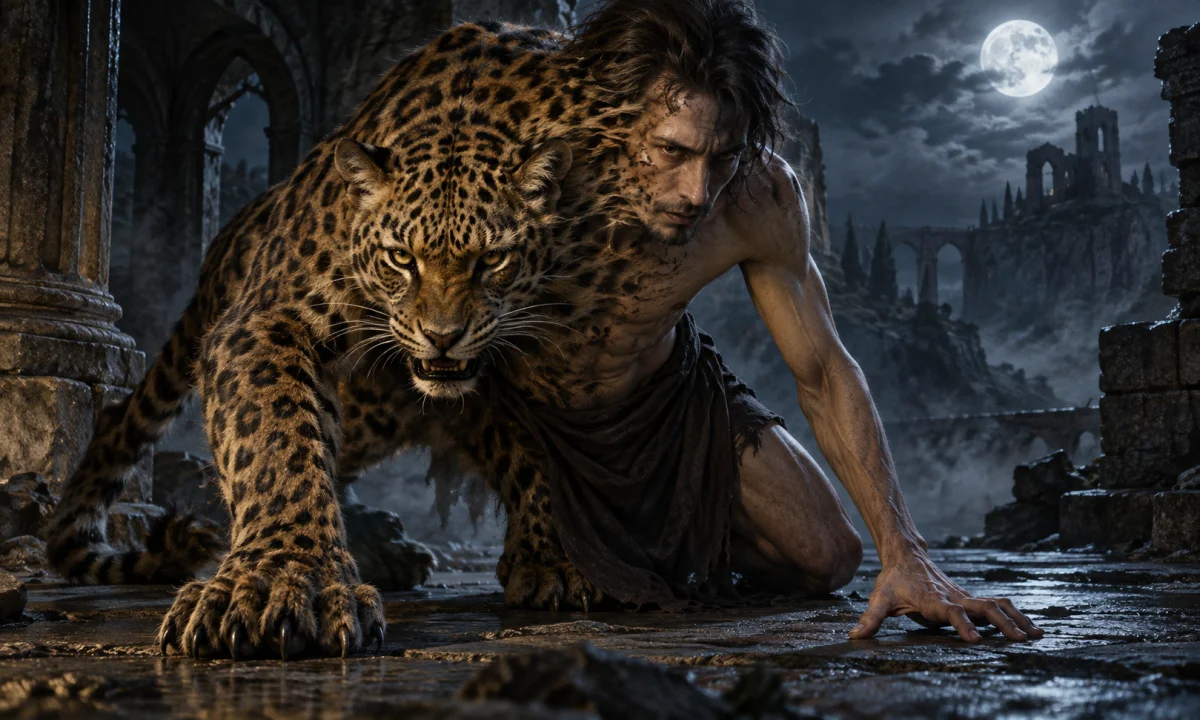
Ose is a demon or spirit described in the early modern grimoire tradition of European ceremonial magic. He is best known from the Ars Goetia, the first section of the Lesser Key of Solomon, where he appears as the fifty-seventh spirit. The text classifies him as a President, a rank within the hierarchy used by that grimoire, and attributes to him teachings concerning knowledge, hidden matters and transformation.
Origins in the grimoire tradition
Ose does not have a clearly attested identity in ancient Mesopotamian, Greek, Roman or biblical religion. His surviving description belongs primarily to the learned magical literature of early modern Europe, especially the catalogues of spirits that Christian demonologists and occult writers organized into ranks, offices and legions. These works presented spirits within a broadly Christian framework, usually treating them as fallen angels, demons or deceptive supernatural powers.
The best-known account appears in the Ars Goetia, a text preserved in manuscripts and printed editions associated with the seventeenth-century Lesser Key of Solomon. The Ars Goetia itself is not a single work created in a vacuum. It draws on earlier magical and demonological materials, including traditions represented in the writings of Johann Weyer and other European authors. As a result, the names, spellings, order of the spirits and details of their descriptions can vary between sources.
Ose should therefore be understood as a figure of grimoire demonology, rather than as a demon with a continuous, well-documented cult or mythology extending from antiquity. The surviving texts provide a compact catalogue entry, not a cycle of myths, religious narratives or historical records describing worshippers and temples.
Name and textual variants
The name is commonly written Ose in modern editions of the Ars Goetia. Other forms include Oso and Vose. These variations are linked to differences in manuscripts, editions, transcription practices and the transmission of unfamiliar names through handwritten magical books.
It is not certain that every form represents a separate being. In many cases, variant spellings reflect the difficulties of copying names from one text to another rather than a deliberate distinction between spirits. At the same time, the evidence does not allow every historical form to be explained with confidence. No universally accepted ancient etymology establishes what the name originally meant or identifies Ose with a known deity or demon from an earlier religious tradition.
The name can also be confused with unrelated words or personal names in other languages. Similar-looking names do not by themselves demonstrate a relationship. In particular, Ose should not automatically be equated with figures from African, Middle Eastern or South Asian traditions merely because their names have comparable spellings in English transliteration.
Rank and classification
In the Ars Goetia, Ose is called a President. This is a formal title within the grimoire's invented or inherited hierarchy. It should not be understood as an office corresponding to a modern political president. The text uses aristocratic and administrative titles—including kings, dukes, princes, marquises, counts, knights and presidents—to arrange spirits according to a system of rank.
Ose is said to command three legions of spirits. A legion in this context is part of the numerical and military imagery used by European demonological catalogues. The statement is not supported by independent historical evidence about an actual supernatural army; it is a feature of the grimoire's classification system.
The title also places Ose among spirits described as having specialized functions. Unlike some entries that emphasize violence, temptation or physical harm, Ose's assigned abilities are chiefly associated with knowledge, revelation and altered identity. His profile combines the promise of learning with the danger of deception and loss of self-awareness.
Appearance and attributed powers
The standard description says that Ose first appears in the form of a leopard and later assumes the shape of a man. The brief notice does not provide a detailed physical portrait, explain the leopard's symbolism or describe a personal history behind the transformation. The animal form is simply part of the spirit's manifestation in the catalogue.
His principal office is to make people wise in the liberal sciences. In the educational language of the period, this phrase referred to fields of learning traditionally associated with a cultivated education, rather than to modern scientific disciplines alone. The medieval and early modern liberal arts were commonly divided into the trivium—grammar, rhetoric and logic—and the quadrivium—arithmetic, geometry, music and astronomy. The exact range intended by the grimoire's wording is not explained in detail.
Ose is also said to provide true answers about divine and secret things. This places him among spirits associated with occult knowledge and revelation. The wording is significant because the grimoire presents supernatural knowledge as something that may be obtained through a spirit, while its Christian setting also implies a moral and theological danger in seeking such knowledge through forbidden means.
A further power attributed to Ose is the ability to change people into other forms. The description adds that the transformed person does not know that the change has occurred. This detail makes the power more disturbing than a simple physical metamorphosis. It suggests an alteration of perception or identity as well as an outward change of shape. The text does not explain whether the transformation is temporary, whether other people can perceive it, or how it can be reversed.
Because the catalogue entry is so concise, later interpretations sometimes expand these powers into a broader theme of illusion, psychological manipulation or identity change. Such interpretations may be consistent with the wording, but they go beyond what the original notice explicitly says.
Stories and relationships
Ose has no substantial narrative cycle in the Ars Goetia. He is not presented as the child, ally, enemy or servant of another named demon, angel or deity. Nor does the text give him a personal legend explaining how he became a demon or why he possesses his particular abilities.
The structure of the grimoire is mainly classificatory. Each spirit receives a name, rank, number, appearance, area of expertise and, in many editions, a symbol or seal. These entries are different from myths in which a character acts across a sequence of episodes. Consequently, claims about Ose's personality, motives or relationships should be treated cautiously unless they are clearly identified as later interpretation.
Some occult writers have connected the spirits of the Ars Goetia with older mythological beings, planetary powers, languages or divine names. Such connections vary considerably and are often products of later occult systems rather than conclusions established by the earliest surviving descriptions. There is no secure historical evidence that Ose was originally a leopard deity, an ancient god of learning or a pre-Christian spirit later renamed by Christian authors.
Knowledge, deception and transformation
Ose's combination of wisdom and metamorphosis reflects several recurring concerns in European demonological literature. Knowledge obtained from a demon could be represented as impressive but morally dangerous. A spirit might answer difficult questions while still misleading the seeker, corrupting judgment or drawing the practitioner into forbidden practices. The catalogue's promise of truthful answers therefore exists within a tradition that treats contact with demons as spiritually hazardous.
The transformation motif adds a second concern: the instability of outward form and personal identity. In folklore and religious storytelling, changing a human into an animal can symbolize punishment, enchantment, disguise or the crossing of boundaries between human and nonhuman worlds. Ose's entry is too brief to assign one definite symbolic meaning, but its emphasis on the victim's ignorance makes deception central to the description.
The leopard may likewise carry several possible associations. Leopards were familiar symbols of wildness, predation and striking physical power in European and biblical imagery, but the text does not state that any one of these meanings was intended. It is safer to describe the leopard as Ose's recorded initial appearance than to present a particular symbolic interpretation as established fact.
Ose and similar figures
Ose is sometimes confused with other spirits in demonological catalogues because many entries share similar powers. Several goetic figures are credited with teaching arts and sciences, revealing hidden information or changing physical form. These overlapping functions do not make them the same being.
Ose should also be distinguished from Proteus, the shape-changing figure of Greek mythology. Proteus is an ancient sea-associated prophetic figure who appears in classical literature, whereas Ose is a grimoire spirit described in early modern European demonology. The shared idea of transformation is not evidence of direct identity.
He is likewise distinct from Ophidian or leopard-like spirits in regional folklore whose traditions developed independently. A resemblance in animal imagery is insufficient to establish a cultural connection. Ose's leopard form comes from the textual catalogue of the Ars Goetia, and should not be merged with every supernatural leopard, shapeshifter or animal demon found elsewhere.
Historical and religious context
The Ars Goetia belongs to a period in which learned magic, astrology, angelology and demonology were often discussed through overlapping bodies of manuscripts. Its descriptions reflect a Christianized universe in which supernatural beings could be ranked, named and summoned within a formal ritual framework. This does not mean that all Christians accepted the catalogue as legitimate religious teaching. Many Christian authorities condemned goetic practices as demonic, illicit or spiritually dangerous.
The text's use of terms such as “divine,” “secret,” “legions” and “president” shows how it combines religious language with bureaucratic and military imagery. These terms create an ordered supernatural world, making invisible powers seem capable of being classified and assigned particular duties. Ose's entry illustrates that method especially well: a named spirit is given a rank, a number of followers, a recognizable appearance and a short list of functions.
Historically, the existence of the written description demonstrates that Ose circulated as a concept in occult literature. It does not prove that a distinct entity corresponding to the description existed independently of those texts, nor does it establish that people successfully contacted such a being. The difference between textual tradition and historical evidence is important when discussing grimoire spirits.
Later reception
Ose continues to appear in modern editions, translations and discussions of the Ars Goetia. Contemporary occult practitioners may treat him symbolically, ritually or as a literal spirit, but these approaches belong to modern interpretation rather than to a single uninterrupted ancient tradition. Modern authors may also expand his themes into psychology, personal transformation, hidden knowledge or altered identity.
He occasionally appears in fantasy fiction, role-playing games, visual media and other forms of popular culture. Such portrayals commonly draw on the leopard form, the title of President or the power of transformation, while adding personalities, histories and relationships absent from the early grimoire accounts. Those creative versions should be recognized as adaptations of a textual demonological figure, not as evidence for additional historical traditions about Ose.
Within the historical record, Ose remains a relatively concise but distinctive spirit of the goetic catalogue: a leopard-forming President associated with learning, revelations about hidden matters and transformations that may pass unnoticed by their victims.