WORLD
WORLD
Kunopegos
Kunopegos is an obscure name associated with demonological catalogues and modern lists of supernatural beings. It is sometimes described as a canine or marine demon, but the evidence for a stable traditional identity is extremely limited. Unlike figures such as Cerberus, Leviathan or the demons named in major Christian grimoires, Kunopegos does not belong to a well-documented mythology with a continuous body of stories, established worship or a consistent appearance.
The name is best treated cautiously. Descriptions attached to it vary, and many accounts repeat information from later encyclopedic or occult compilations rather than from an identifiable ancient religious tradition. Kunopegos is therefore an example of how demonological names can circulate independently of the cultures, languages and texts that originally produced more securely attested supernatural figures.
Origins and cultural setting
No ancient cult, scripture or major mythological cycle securely identifies a demon called Kunopegos. The name is not a prominent figure in the surviving mythologies of ancient Greece, Rome, Scandinavia, Egypt or Mesopotamia. Nor is it a standard member of the demon hierarchies found in influential Christian magical texts such as the Ars Goetia.
Its modern reputation appears to come from catalogue-style demonology: lists that gather together names of demons, spirits and legendary beings, often assigning each one a short description. Such lists may preserve names from older occult literature, but they can also transmit errors, variant spellings or unsourced additions. In the case of Kunopegos, it is difficult to separate an earlier name from later attempts to explain or expand it.
Some descriptions place Kunopegos among spirits connected with the sea. In these accounts, it is associated with storms, dangerous waters or shipwreck. Other versions emphasize a dog-like form. Neither set of details is supported by a broad, independent tradition comparable to the stories surrounding well-known canine guardians or marine demons. They should be presented as later attributed characteristics rather than as universally accepted features.
The name and its uncertain identity
Kunopegos has an appearance that suggests a Greek or Greek-influenced formation, particularly because of the element kuno-, which resembles Greek words connected with dogs. That resemblance alone does not establish a reliable etymology. The spelling may have passed through different languages, transliteration systems or editorial traditions, and the original form is not certain.
Several related-looking words can create confusion. Ancient Greek used compounds involving kyōn or kyn-, meaning “dog,” while Greek mythology also included terms for dog-headed or dog-shaped beings. A similar appearance, however, does not prove that Kunopegos derives from a particular ancient Greek myth. The name may be a corruption, an altered transliteration or a later occult construction.
There is also no consistent agreement about whether Kunopegos is a personal demon, a type of spirit or simply a name copied from one list to another. Some modern entries treat it as an individual supernatural being. Others effectively use it as a label for a dog-like or sea-associated demon. This uncertainty is important: a short dictionary entry can give the impression of a fully developed figure even when no narrative tradition survives.
Reported appearance
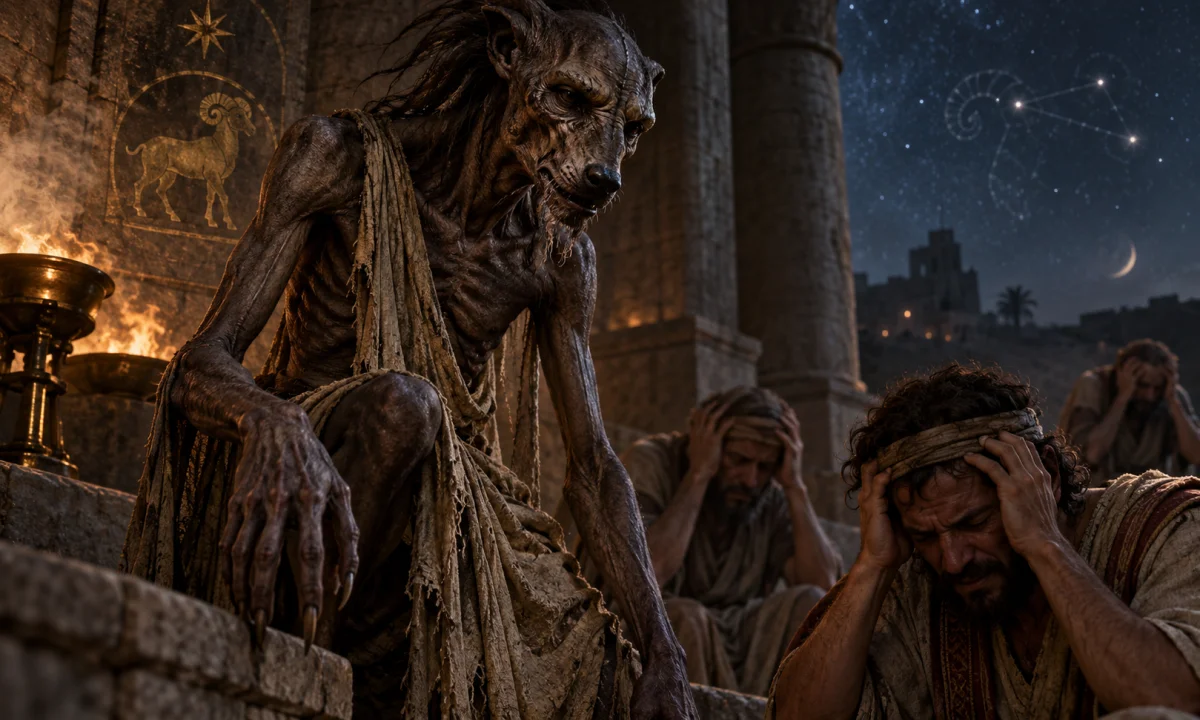
The most common modern descriptions connect Kunopegos with a canine appearance. The exact form is not stable. It may be presented as a dog, a dog-headed creature or a demonic animal associated with the sea. Detailed physical features—such as size, colour, horns, wings, armour or a human body—do not belong to a securely established traditional description and should not be treated as authentic attributes.
When Kunopegos is portrayed as a sea-dwelling dog-like creature, the image combines two familiar supernatural motifs:
- the dog as a guardian, hunter or boundary creature;
- the sea as a dangerous and unpredictable realm beyond ordinary human control.
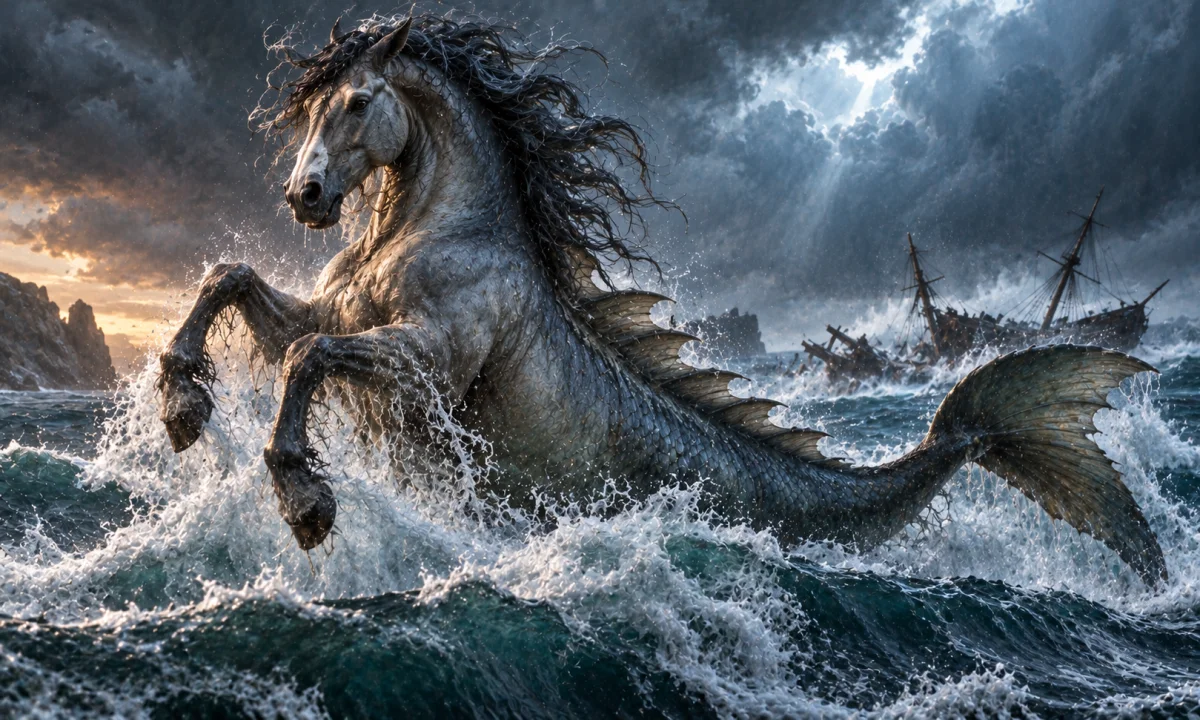
That combination is symbolically understandable, but symbolism should not be confused with historical evidence. A modern illustration may develop the figure much further than the surviving name warrants. Artistic depictions of Kunopegos therefore reflect the illustrator’s interpretation, not a fixed iconography inherited from an ancient religious tradition.
Attributed powers and role
Accounts that describe Kunopegos as a marine demon commonly associate it with storms or peril at sea. Some may imply that it causes shipwrecks or threatens sailors. These claims resemble the functions assigned to many water spirits, storm demons and monstrous guardians in different cultures. They are not accompanied by a known cycle of myths explaining Kunopegos’s origin, motives or relationships.
The attribution of storms is especially difficult to evaluate because maritime folklore frequently personifies danger. A storm could be interpreted as the work of a god, demon, monster, ancestor or offended spirit depending on the culture and religious setting. A later catalogue may assign the general function of “causing storms” to a named being without preserving any original story.
There is no reliable evidence that Kunopegos was traditionally invoked in a standard ritual, ranked within a recognized hierarchy or believed to grant a particular form of knowledge or power. Claims that assign it a precise office, rank or magical ability should therefore be regarded as speculative unless tied to a clearly identifiable historical source.
Stories and relationships
No well-known myth recounts Kunopegos’s birth, deeds, defeat or relationship with another god or demon. It is not the subject of a major epic, saint’s legend or widely recorded folktale. There is likewise no established account of a particular hero encountering it.
This absence distinguishes Kunopegos from better-attested canine supernatural beings. Cerberus, for example, has a defined place in Greek mythology as the guardian of the underworld and appears in stories about Heracles and the realm of the dead. Black dogs in British and Irish folklore occur in numerous local traditions, often as omens, guardians or frightening apparitions. Kunopegos has no comparable narrative range.
Nor is there a known family or hierarchy linking Kunopegos to other sea demons. It should not automatically be described as a servant of Satan, a subordinate of a particular demon king or a member of a named pantheon. Such relationships are common additions in modern demon encyclopedias, but they are not established for Kunopegos by a widely recognized traditional source.
Religious and folkloric interpretation
In Christian demonology, the term “demon” has often been used broadly for spirits understood as hostile to God, harmful to human beings or connected with pagan religious practices. Medieval and early modern writers did not always agree about the identity, number or hierarchy of demons. Later occult authors expanded these systems further, sometimes combining biblical, classical, medieval and folkloric material.
Kunopegos fits most comfortably within this later classificatory environment rather than within a clearly documented local religion. Calling it a demon describes how some catalogues classify the name; it does not demonstrate that a historical community worshipped, feared or ritually addressed a being of that name.
The canine aspect can be interpreted through several recurring cultural associations. Dogs may guard thresholds, accompany hunters, detect the presence of the dead or guide souls. Because they move between domestic and wild spaces, they can also become liminal animals in folklore. A demonic dog may therefore represent danger at a boundary: the edge of a settlement, the entrance to the underworld or the shoreline between land and sea.
Marine interpretations add another threshold. The sea has often symbolized chaos, death, foreignness and forces that cannot be controlled by ordinary human laws. A dog-like spirit of the sea would combine the familiar with the alien: an animal known to humans, transformed into a threatening guardian of an unreachable environment. This is a useful comparative interpretation, but it remains an interpretation rather than evidence of Kunopegos’s original meaning.
Distinction from similar figures
Cerberus
Kunopegos should not be identified with Cerberus, the many-headed watchdog of the Greek underworld. Cerberus is a major mythological figure with a substantial literary and artistic tradition. Although both may be represented as canine supernatural beings, Cerberus guards the dead and belongs to Greek underworld mythology, while Kunopegos has no equivalent securely documented role.
Cynocephali
The cynocephali were dog-headed peoples or beings described in some classical, medieval and later accounts. Their status varied: some writers treated them as monstrous human races, while others connected them with marvel literature or religious legend. They are not the same as Kunopegos. A resemblance based on the dog motif does not establish identity or shared origin.
Black dogs and spectral hounds
Black dogs and spectral hounds occur in the folklore of the British Isles and elsewhere. They may appear as omens of death, guardians of particular places or frightening supernatural animals. These traditions are regional and diverse, and none should be automatically folded into Kunopegos’s identity. A catalogue entry describing Kunopegos as dog-like does not turn every black-dog legend into a story about Kunopegos.
Sea monsters and water spirits
Kunopegos is also distinct from named marine beings such as the Greek Scylla, the Norse Jörmungandr or various water horses, merfolk and river spirits. Those beings belong to particular mythological or folkloric traditions and have their own narratives. The occasional description of Kunopegos as a sea demon is too general to establish a connection with any of them.
Sources, transmission and uncertainty
The main difficulty surrounding Kunopegos is not a lack of imaginative descriptions but a lack of verifiable continuity. A name can be repeated many times in demon lists while still resting on a single uncertain entry. Repetition may create an appearance of consensus even when later writers have simply copied one another.
For that reason, claims about Kunopegos should be separated into levels of confidence:
- Relatively secure: the name is used in some modern or later demonological catalogues.
- Commonly attributed: the being is sometimes linked with a dog-like form, the sea, storms or maritime danger.
- Uncertain: the original language, earliest appearance, precise meaning and cultural setting of the name.
- Unsupported as a general tradition: a fixed appearance, established hierarchy, canonical stories or widespread historical worship.
This approach prevents a catalogue label from being mistaken for a complete mythology. It also leaves room for the possibility that future examination of obscure manuscripts or regional records could clarify the name, while acknowledging that no such clarification is currently part of its generally recognized identity.
Modern reception
Kunopegos has little presence in mainstream popular culture compared with famous demons and monsters. Its obscurity makes it more likely to appear in occult reference lists, online bestiaries, independent fiction, role-playing material or games that draw on large collections of supernatural names. In these settings, creators may give Kunopegos a detailed body, personality, history and set of powers.
Such portrayals can be imaginative and effective, but they are modern adaptations, not evidence for an ancient or widely shared tradition. A fantasy work may turn Kunopegos into a giant hound, a sea-dwelling guardian or a storm-bringer because those traits fit the name’s later associations. The resulting character should be distinguished from the uncertain catalogue figure.
Kunopegos is therefore most accurately understood as a marginal and poorly documented demonological name. Its interest lies less in a large body of traditional stories than in the way supernatural catalogues preserve, reshape and sometimes amplify fragmentary names. The dog and sea imagery attached to it draws on powerful cross-cultural symbols, but the historical identity of the being remains unsettled.