WORLD

Crocell
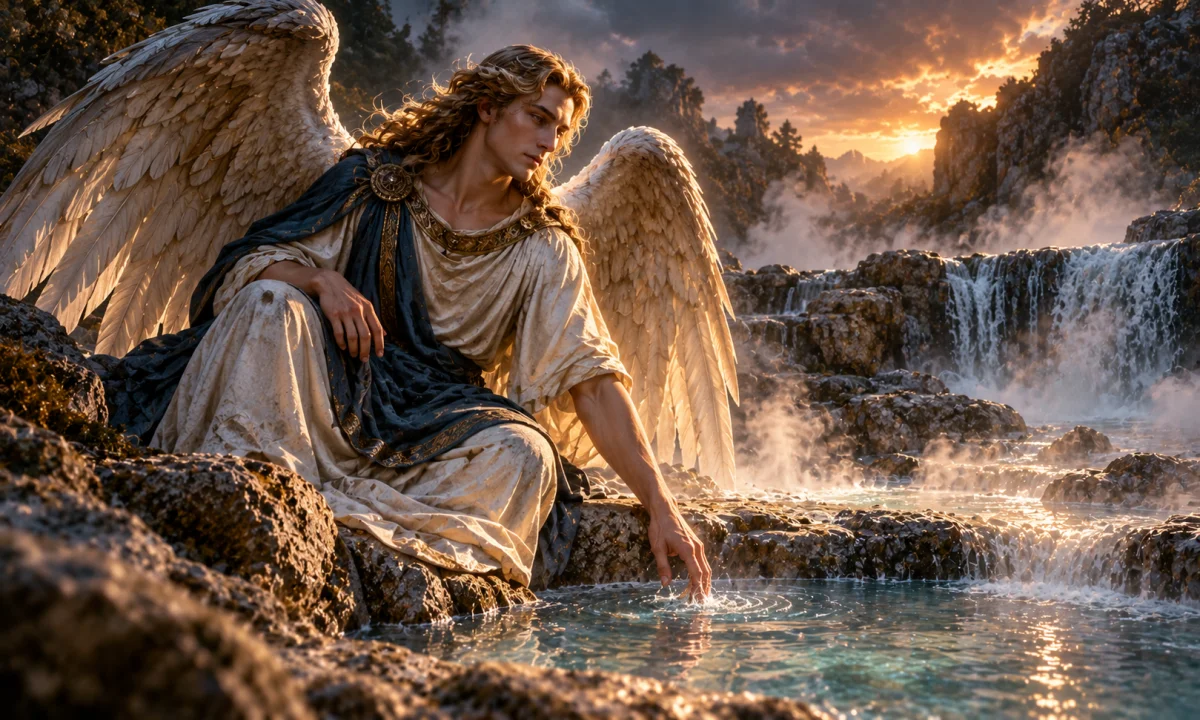
Crocell is a demon of early modern European grimoire tradition, best known as the forty-ninth spirit in the Ars Goetia, the first part of the Lesser Key of Solomon. He is described as a great duke who appears in the form of an angel and is associated with hidden knowledge, geometry, the liberal sciences, and the sound and warmth of water. Crocell belongs to a literary system of ceremonial demonology rather than to a widely attested ancient mythology or an independent folk religion.
Origins in Western grimoire tradition
The principal descriptions of Crocell come from demonological catalogues that circulated in early modern Europe. His most familiar account appears in the Ars Goetia, a Solomonic grimoire concerned with the names, ranks, appearances, abilities, and conjuration of spirits. The work survives through manuscript traditions associated with the seventeenth century, although its contents draw on older magical and demonological materials.
Crocell is also associated with lists of spirits found in Johann Weyer’s Pseudomonarchia Daemonum, a sixteenth-century work that presents a catalogue of demons and their supposed offices. The wording and ordering of entries can vary between manuscripts and printed editions. As a result, details attributed to Crocell should be understood as features of a textual tradition rather than as evidence of a single, consistently worshipped being with a fixed history.
These catalogues emerged within a Christian European environment in which older magical practices, biblical themes, late antique traditions, medieval learned magic, and popular beliefs about spirits were frequently combined. The demons in such books were generally presented as beings subject to divine authority and capable of being summoned, questioned, constrained, or dismissed through ritual. Their classification reflects the concerns of occult writers and theologians, not a universally recognized hierarchy shared by all Christian communities.
Name and identity
The name is commonly written Crocell, but variant spellings such as Crokel and Procel may appear in related discussions or editions. The exact origin and meaning of the name are uncertain. There is no secure scholarly basis for assigning it a definite etymology from a particular ancient language, and proposed connections should therefore be treated cautiously.
Crocell should not be confused with a deity, saint, angel from a major scriptural tradition, or a figure from a well-established pre-Christian mythology. In the sources that name him, he is a demon or spirit within a learned catalogue of magical beings. His apparent angelic form does not make him an angel in the theological sense used by mainstream Jewish, Christian, or Islamic traditions. The description reflects the visual language of the grimoire, where spirits may adopt forms associated with rank, authority, or deceptive appearance.
Rank and classification
In the Ars Goetia, Crocell is assigned the rank of duke. The text states that he governs forty-eight legions of spirits. These numbers are part of the hierarchical structure used by the grimoire. They resemble aristocratic and military organization, with kings, princes, dukes, marquises, presidents, and other offices arranged in a supernatural court.
The rank of duke does not necessarily indicate a consistent theological status. It is one of several administrative titles used to organize the catalogue and to distinguish spirits according to their supposed authority. Different demonological works may assign different ranks or attributes to similarly named entities, and the presence of a spirit in one catalogue does not guarantee that every later source will describe it in the same way.
Appearance and traditional attributes
Crocell is said to appear in the form of an angel. The surviving descriptions do not provide a detailed physical portrait comparable to the elaborate illustrations found in some later occult books. They identify the general form in which the spirit is expected to manifest, but do not establish a universally recognized costume, colour, number of wings, or facial appearance.
His principal abilities are intellectual and elemental in character. The traditional description credits him with speaking of hidden or secret matters and with teaching geometry and the liberal sciences. In medieval and early modern educational language, the liberal arts referred to disciplines regarded as suitable for a free person’s education. They traditionally included grammar, rhetoric, logic, arithmetic, geometry, music, and astronomy. The phrase does not necessarily mean that Crocell was associated with a modern scientific institution or with every academic subject.
The reference to geometry is especially notable because geometry held both practical and philosophical importance in premodern thought. It was connected with architecture, surveying, astronomy, proportion, and ideas about the mathematical order of creation. A spirit who teaches geometry therefore belongs to a tradition in which occult knowledge and learned disciplines could overlap. The text does not explain a specific theorem, school of mathematics, or body of instruction attributed to Crocell.
Crocell is also said to make a great noise resembling the sound of rushing or roaring waters. This auditory image gives the spirit a more atmospheric quality than many catalogue entries, which concentrate only on the information a demon supposedly provides. The sound may be read literally within the grimoire’s ritual imagination, but the text does not offer a detailed myth explaining why water is linked to Crocell.
Another traditional attribute is the ability to warm waters. This detail has encouraged later readers to associate Crocell with hot springs, thermal waters, or elemental water. Such associations are interpretations rather than fully developed ancient cultic connections. The original catalogue presents the ability briefly and does not identify a sacred lake, river, spring, sea, or water deity connected with the spirit.
Knowledge, secrecy and water
The combination of hidden knowledge, geometry, rushing water, and warmth makes Crocell unusual within the Goetic catalogue. His profile joins two different kinds of imagery: the disciplined knowledge of the liberal sciences and the uncontrolled force of natural sound. Water can conceal, reflect, erode, carry, and transform, while geometry suggests measurement, order, and intelligibility. Modern interpreters sometimes treat these elements as a symbolic unity, but the historical text itself does not provide a formal explanation of their relationship.
The promise to reveal hidden things follows a common pattern in magical literature. Spirits are often assigned access to secrets, occult information, distant events, or specialized learning. Such claims served the dramatic and ritual purpose of the grimoire, presenting the spirit as a source of knowledge beyond ordinary human reach. They should not be confused with evidence that historical practitioners obtained verifiable scientific instruction from a being named Crocell.
The waters associated with Crocell may also have resonated with the sensory experience of ritual. A roaring sound, the heat of water, and the appearance of an angelic figure would all contribute to an atmosphere of supernatural presence. Nevertheless, surviving descriptions do not preserve a separate legend about Crocell’s birth, family, battles, former heavenly office, or relationship with a particular deity.
Stories and relationships
Crocell has no substantial myth cycle in the way that figures such as Heracles, Loki, Isis, or the archangel Michael do. The Goetic material is primarily catalogue-based: it records a name, rank, appearance, powers, and number of legions. It does not narrate a sequence of episodes in which Crocell acts as a central character.
Nor does the standard description establish a family relationship between Crocell and other demons. Later occult writers, artists, novelists, and game designers may place him within larger infernal courts or assign him alliances and rivalries, but these additions should not be projected backward into the early modern sources. The claim that he rules forty-eight legions is a statement about his rank in the catalogue, not a narrative account of named followers.
The name of Solomon is relevant to the broader grimoire framework, since the Ars Goetia presents its spirits within a Solomonic tradition. That setting does not mean that Crocell appears in the Hebrew Bible or in early Jewish accounts of Solomon. The famous biblical stories of Solomon do not contain a character matching the full Goetic profile of Crocell. The connection belongs to later magical literature that attributed authority over spirits to the biblical king.
Religious and cultural context
European Christian demonology often classified spirits according to their presumed opposition to God, their role in temptation, or their participation in forbidden magic. Grimoires could nevertheless give demons highly specialized abilities, including knowledge of languages, sciences, treasure, warfare, music, or natural phenomena. This apparent contradiction reflects the layered history of occult literature: demons were condemned as spiritually dangerous while also being described as powerful and knowledgeable.
The Goetic presentation of Crocell should therefore be distinguished from official Christian teaching. There is no general Christian doctrine that recognizes Crocell as a canonical demon with an established place in scripture. Catholic, Orthodox, Protestant, and other Christian traditions have differed in their treatment of demonological literature, and many would regard ceremonial attempts to summon spirits as religiously prohibited or spiritually hazardous.
It is also inaccurate to describe Crocell as an ancient water god merely because the texts mention water. A god normally belongs to a cult, mythic tradition, ritual system, or inherited religious community. Crocell’s documented identity is instead tied to early modern demonological books. The water imagery is an attribute within those books, not proof of an older independent religion.
Symbols and later interpretations
Some occult editions provide a seal or sigil for Crocell. These designs are part of the manuscript and grimoire tradition surrounding the spirit, but their exact forms can differ between editions. A sigil should not automatically be treated as an ancient emblem. Many such diagrams belong to the historical practice of ceremonial magic and were transmitted through manuscripts, copied books, and modern reproductions.
Later occultists have expanded Crocell’s associations by connecting him with elemental water, thermal currents, mathematical knowledge, sound, or meditation. These correspondences may be meaningful within particular magical systems, but they are not all present in the earliest surviving descriptions. The distinction between textual attribute and later correspondence is important: the former is recorded in a source, while the latter reflects interpretation or adaptation.
Distinction from similar figures
Crocell is sometimes confused with other beings whose names or attributes involve water, knowledge, or angelic appearance. He is not the same figure as Oceanus, the Greek divine personification of the world-ocean, or Poseidon, the Greek god of the sea. He is also not equivalent to Neptune, the Roman counterpart of Poseidon, or to water spirits from regional folklore such as mermaids, kelpies, nixies, or river guardians.
Nor should Crocell be merged with Raziel, the angel associated in later Jewish mystical tradition with secrets and esoteric knowledge, simply because both may be linked by modern writers with hidden wisdom. Crocell’s angelic appearance is a feature of a demonological catalogue, whereas Raziel belongs to a different religious and textual context. Similar themes do not establish identity.
The spelling variants of Crocell also require care. A different spelling may represent copying, transliteration, editorial preference, or a genuinely different entry. Without examining the specific manuscript or edition, it is unsafe to assume that every form—especially names that merely sound alike—refers to exactly the same spirit.
Modern popular culture
Crocell appears occasionally in modern occult writing, fantasy fiction, role-playing games, manga, anime, video games, and other media influenced by demonological catalogues. In these settings, creators may redesign him as a warrior, a water elemental, a scholar, a monstrous animal, or a powerful member of an infernal hierarchy. Such portrayals can make the name more familiar, but they are creative adaptations rather than evidence about the early modern tradition.
Modern depictions often emphasize the most visually dramatic features: angelic appearance, roaring water, supernatural heat, and mastery of hidden knowledge. They may also expand the brief catalogue entry into a complete personality and biography. Unless a work explicitly presents a historical reconstruction, these additions should be understood as fictional world-building. The traditional Crocell remains a comparatively concise entry in Western ceremonial demonology: a duke, appearing as an angel, linked with secret knowledge, geometry and the liberal sciences, the sound of rushing water, and the warming of waters.