WORLD
WORLD
Behemoth
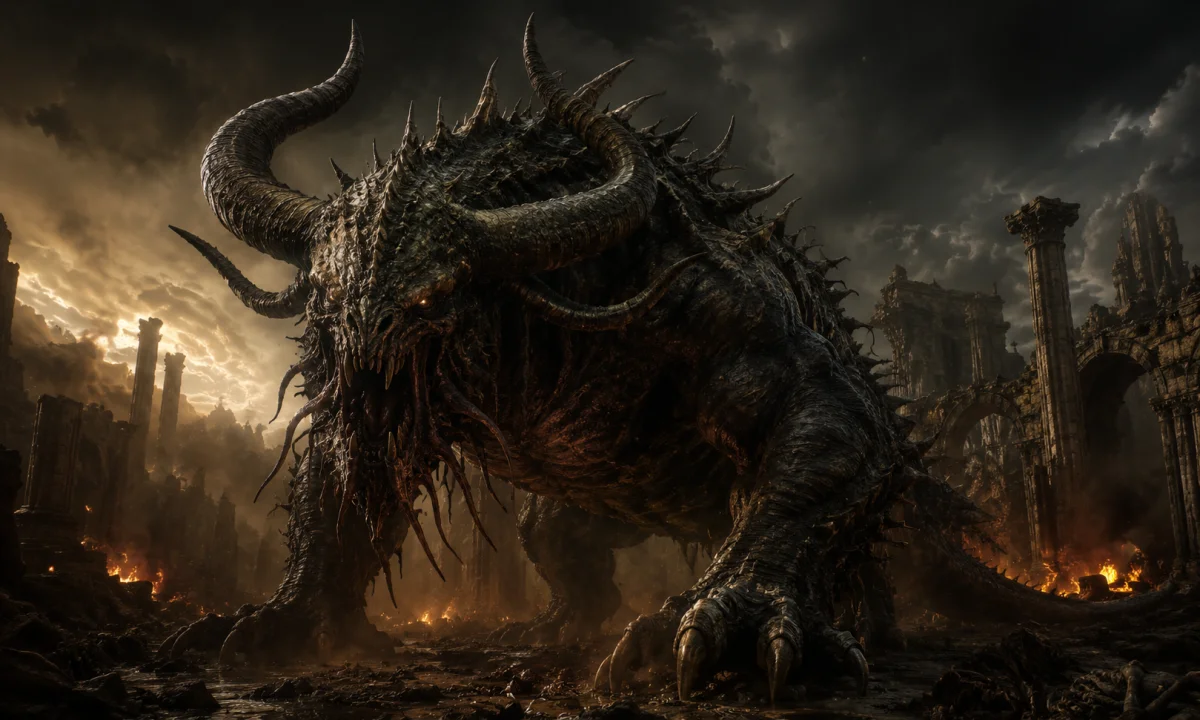
Behemoth is a colossal creature described in the Hebrew Bible, chiefly in the divine speeches of the Book of Job. Its name and nature have been debated for centuries. In the biblical passage, Behemoth is not presented as a demon in the later Christian sense, but as one of the greatest animals created by God: immensely strong, difficult or impossible for humans to control, and entirely subordinate to divine power. Later Jewish, Christian, occult and popular traditions transformed or reclassified the figure, often treating Behemoth as a monstrous spirit or demon. Those later portrayals should be distinguished from the older biblical image.
Behemoth in the Book of Job
The principal description occurs in Job 40:15–24. After a long dispute about suffering, justice and human limitations, God answers Job from a whirlwind. Rather than giving a philosophical explanation for Job’s misfortunes, the divine speeches present a series of creatures whose power and wildness exceed human control. Behemoth is the first of the two most extraordinary beings in this sequence; the second is Leviathan.
God tells Job to look at Behemoth, “which I made with you,” emphasizing that the creature belongs to the same created order as humanity. Behemoth eats grass like an ox, yet possesses extraordinary strength. Its loins and belly are described as powerful, its bones as tubes of bronze, and its limbs as bars of iron. The creature lies beneath lotus plants or in a hidden marshy place, protected by reeds and willows.
The passage also states that Behemoth’s tail is like a cedar. This detail has made the animal difficult to identify with any ordinary species. The creature is portrayed as a land animal, but its size, strength and unusual anatomy give it a legendary quality. It is not simply an animal in a natural-history catalogue. It is an image of untamable created power.
The Jordan River is said to surge against Behemoth’s mouth, yet the creature remains unafraid. Humans cannot capture it by ordinary means, and no one can pierce its nose with a snare. The final emphasis is not that Behemoth attacks people or tempts them, but that human beings cannot master it. The creature’s existence challenges the assumption that everything in creation has been arranged for human use.
The name and its meaning
The Hebrew name is usually written Behemoth in English. It is related to the Hebrew word behemah, meaning an animal, beast or domesticated quadruped. Grammatically, behemoth resembles a plural form, often translated literally as “beasts.” In the Book of Job, however, it behaves as the name of a single creature.
Several explanations have been proposed. The form may be an intensive or majestic plural, suggesting an animal of exceptional size or power. It may also preserve an older expression whose original force was no longer transparent to later readers. Some interpreters have understood the name as “the great beast,” while others leave it untranslated because its precise meaning in the passage is uncertain.
The spelling Behemoth reflects the traditional English form. Other transliterations, such as Bəhēmōth or Behemot, represent attempts to reproduce Hebrew pronunciation more closely. These are not necessarily different beings. The form Behemoth is most familiar in English religious writing, demonology and fantasy literature.
Animal or cosmic monster?
The identity of Behemoth has never been settled. One influential interpretation identifies it with the hippopotamus. A hippopotamus is a large, semi-aquatic, grass-eating animal associated with rivers and marshes, and its formidable strength suits the description in Job. The references to reeds, water and vegetation also fit a massive river animal better than a purely terrestrial predator.
Other readers have proposed an elephant, a rhinoceros, a wild bull or a composite creature based on several powerful animals. The reference to a tail “like a cedar” is especially difficult for a hippopotamus, whose tail is short. Some interpreters therefore understand the comparison as poetic exaggeration, while others argue that the passage may have been altered, misunderstood or based on a different animal known to the original audience.
Another possibility is that Behemoth was never intended to correspond to a single zoological species. Ancient poetry often uses recognizable features to create a super-animal. Behemoth eats like an ox, inhabits watery places, has extraordinary bones and possesses a tail like a tree. The result is an animal that resembles known creatures while exceeding ordinary nature.
Scholarly interpretations differ partly because the Book of Job is poetry rather than a scientific description. Its purpose is to display the scale and variety of creation, not to provide a taxonomic identification. The question “What animal is Behemoth?” is therefore useful but incomplete. In the poem, Behemoth functions as a dramatic embodiment of strength, wilderness and human limitation.
Behemoth and Leviathan
Behemoth is closely associated with Leviathan in Jewish and Christian interpretation, although the two are not the same being. Behemoth is primarily a land creature, while Leviathan is associated with the sea. In Job, both appear in divine speeches that emphasize the inability of human beings to control the most powerful elements of creation.
The Book of Job does not explicitly call either creature a demon or an enemy of God. Both are presented as creatures made by God and placed within the divine order. Their danger and magnificence help communicate a theological point: the world is larger, wilder and less human-centered than Job can comprehend.
Because Behemoth and Leviathan appear together in later religious imagination, they sometimes become a paired set of primordial monsters. This association is especially strong in apocalyptic and medieval traditions. It should not obscure the difference between them. Behemoth is not a second name for Leviathan, nor is Leviathan simply Behemoth’s aquatic form in the oldest biblical passage.
Jewish apocalyptic and rabbinic traditions
Later Jewish writings expanded the biblical images of Behemoth and Leviathan. In the First Book of Enoch, a work of Jewish apocalyptic literature, Behemoth is described as a great land creature, while Leviathan occupies the depths of the sea. They are kept apart because the world could not contain their combined power. In this setting, both figures belong to an eschatological landscape associated with the end of the age and the judgment of the wicked.
The details vary among manuscripts, translations and interpretations. The apocalyptic tradition does not simply repeat Job. It places Behemoth and Leviathan within a more developed cosmic scheme, in which enormous creatures are reserved for a future event or final dispensation. Their separation expresses the scale of their power rather than a moral opposition between good and evil.
Rabbinic and later Jewish traditions also speak of a future feast involving Behemoth, Leviathan and, in some versions, another enormous creature associated with the land or the air. These stories developed within broader discussions of the world to come, resurrection and the reward of the righteous. The feast is often understood symbolically, although some traditional readers treated the creatures as real elements of the future order.
These traditions helped turn Behemoth from a striking animal in biblical poetry into a participant in sacred history. Even so, Jewish interpretations have not been uniform. Some emphasize a literal monstrous creature, some read the figure allegorically, and others treat the passages as poetic descriptions of the natural world.
Is Behemoth a demon?
In its earliest and most influential source, Behemoth is not a demon. The Book of Job does not describe it as a rebellious spirit, tempter, fallen angel or servant of evil. It does not seek human souls, oppose God or possess people. Its overwhelming power is part of the created world, not evidence of demonic allegiance.
The classification of Behemoth as a demon belongs mainly to later demonological and occult systems. Medieval and early modern writers sometimes reorganized biblical monsters and symbolic figures into lists of demons, often assigning them moral vices or infernal offices. In such contexts, Behemoth could be associated with gluttony, bodily appetite, drunkenness or gross physical excess. These associations reflect later moral interpretation rather than a clear role in the Book of Job.
There is no single universally authoritative demonological profile for Behemoth. Different occult, theological and literary sources give the name different meanings. Some describe a gigantic animal-like demon; others use Behemoth as a general symbol of appetite or brute force. Claims that Behemoth has one fixed rank, appearance or office in Hell should therefore be identified as products of particular later traditions, not as universal facts.
Appearance and powers
The biblical description provides the foundation for most later portrayals. Behemoth is enormously strong, herbivorous and connected with rivers, marshes and dense vegetation. Its body is nearly invulnerable by ordinary human weapons, and its bones are compared with metal. The creature’s strength is physical rather than magical in the narrow sense.
Its most important power is unmastered existence. Behemoth does not need to cast spells or command armies to appear terrifying. It is frightening because it cannot be domesticated, hunted or restrained by human ingenuity. The poem makes this point through questions about capture and control, directing Job to recognize the limits of human authority.
The comparison with a cedar gives the tail a legendary scale, while the iron and bronze imagery makes the body resemble a living fortress. These details may be poetic hyperbole, symbolic language or remnants of older monster lore. The text does not explain whether Behemoth has supernatural powers beyond its size and strength.
Symbolism and interpretation
Behemoth can represent the wildness of creation, the limits of human knowledge or the physical forces that human beings cannot command. In the Book of Job, the creature does not answer Job’s questions about suffering directly. Instead, it forms part of a larger vision in which divine wisdom encompasses beings and processes beyond human judgment.
Some theological interpretations view Behemoth as evidence that dangerous creatures can still belong to a good creation. Its existence complicates the assumption that everything valuable must be useful, tame or safe. The creature eats grass and lives in its own environment; it is not evil merely because it is powerful or potentially dangerous.
Other interpretations treat Behemoth as a symbol of chaos held within divine limits. This reading is influenced by comparisons with ancient Near Eastern traditions in which gods battle sea monsters or forces of disorder. The connection is possible as a matter of comparative mythology, but it should not be presented as a simple identification. The biblical text does not narrate a battle between God and Behemoth. God creates and describes the creature rather than defeating it.
Modern scholars also examine the passage through the history of animal imagery, ancient poetry and the ecology of the Levant and surrounding regions. Such approaches may support a hippopotamus interpretation, a composite-monster interpretation or a deliberately ambiguous reading. None has eliminated the uncertainty surrounding the name.
Medieval and early modern reception
As biblical material circulated through Christian commentary, sermons, illustrated manuscripts and demonological writing, Behemoth acquired meanings beyond the Book of Job. The enormous animal could be used as an emblem of gluttony and uncontrolled appetite, particularly when moral writers interpreted monstrous bodies as images of spiritual vice.
In some Christian traditions, Behemoth was placed among infernal beings even though the biblical passage does not do so. Artists and writers consequently portrayed it with features drawn from elephants, hippopotamuses, bulls, bears or dragons. There was no stable canonical appearance. Its image depended on the artist’s access to biblical commentary, bestiary traditions and imaginative conventions.
The figure also became useful in discussions of the boundary between literal and symbolic interpretation. Some readers regarded Behemoth as an actual ancient animal whose description had been magnified by poetry. Others regarded it as a primordial monster or allegorical representation of earthly power. These approaches could coexist, since premodern writers did not always separate natural history, theology and symbolism in modern ways.
Behemoth in modern culture
Modern fantasy, horror, role-playing games, comics and other forms of popular culture frequently use Behemoth as the name of a gigantic monster. In these settings, it may be depicted as a horned quadruped, a dragon-like beast, an armored animal or an embodiment of destructive strength. Such versions often combine details from Job with features borrowed from dragons, demons and kaiju-like creatures.
Some modern works also use Behemoth as a name for a demon of gluttony or a lord of monstrous beings. That portrayal belongs to contemporary adaptation or to specific later occult traditions, not to the original biblical account. The name’s continuing appeal comes from its unusual position: Behemoth is ancient, scriptural and mysterious, yet its identity was already uncertain within the history of interpretation.
When Behemoth appears in modern fiction, its meaning may range from a literal gigantic animal to a metaphor for industrial power, political violence, technological systems or uncontrolled appetite. These uses draw on the creature’s long-established associations with size and force, while often leaving behind the theological setting of the Book of Job.
Distinguishing Behemoth from related figures
- Leviathan: A separate biblical monster associated especially with the sea. Later traditions often pair Leviathan with Behemoth, but the two are not interchangeable.
- Bahamut: A figure in Arabic and Islamic cosmographical tradition whose name is related historically to the Arabic form of Behemoth. Bahamut should not automatically be treated as the same being. Its later descriptions and cultural setting differ substantially from the Hebrew biblical creature.
- Behemoth as a demon: A later classification found in some Christian demonological and occult traditions, not the primary role of Behemoth in Job.
- Hippopotamus: A proposed natural counterpart, not a universally accepted identification. The biblical description may be poetic or composite rather than zoologically exact.
- Generic giant monsters: Modern fantasy often uses “behemoth” as a common noun for anything enormous. This broad usage derives from the creature’s reputation but does not establish a separate mythological being.
Behemoth therefore occupies several different categories depending on the tradition being discussed. In the Book of Job, it is a magnificent and untamable creature of God’s creation. In Jewish apocalyptic tradition, it becomes a land monster reserved for an extraordinary future. In later demonology, it may be recast as an embodiment of appetite or a demonic power. In modern popular culture, it is commonly a name for a colossal beast. Keeping these layers separate preserves both the uncertainty of the ancient text and the richness of the figure’s later history.