WORLD
WORLD
Amdusias
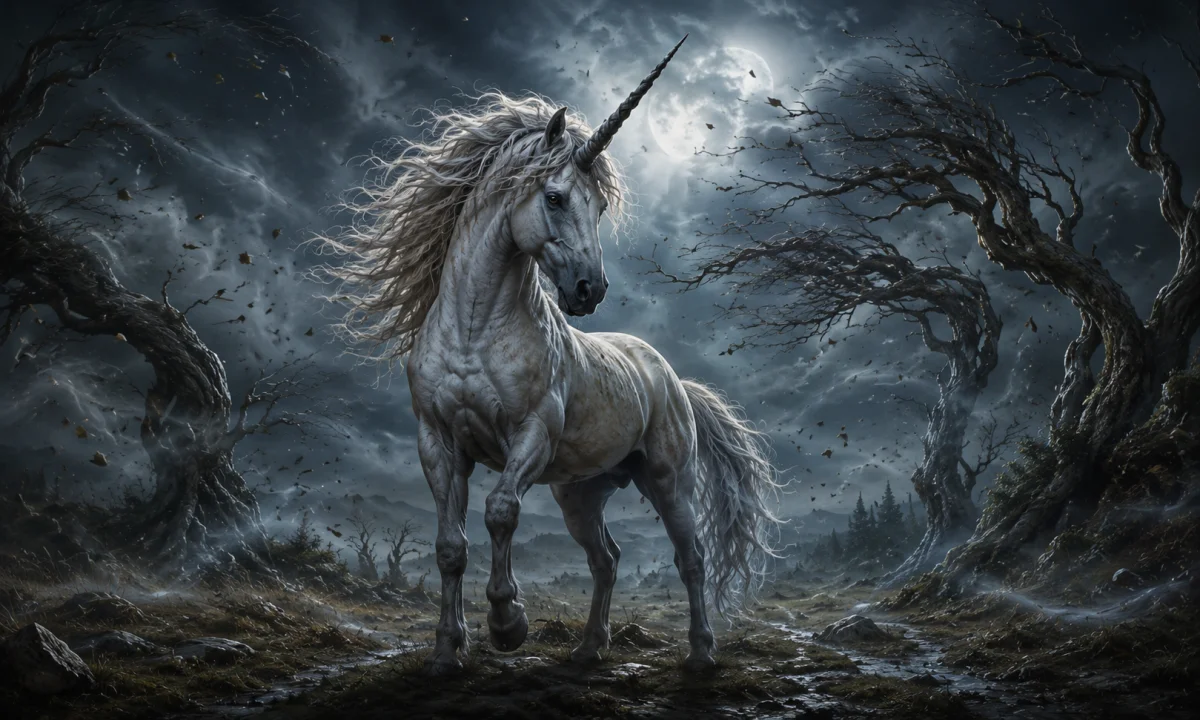
Amdusias, also spelled Amduscias or Amducias in different texts, is a demon and infernal duke described in early modern European demonological literature. He is best known from the Ars Goetia, the first part of the Lesser Key of Solomon, where he is listed among the seventy-two spirits associated with ceremonial magic. His traditional description combines an initially animal-like appearance with unusual powers over music, trees and supernatural attendants.
Origins in European demonology
Amdusias does not belong to a clearly documented ancient mythology, and there is no reliable evidence that he was worshipped as a god or spirit in the ancient world. His surviving identity comes primarily from the learned demonology and ritual magic of early modern Europe. These works arranged numerous spirits into ranks, offices and hierarchies, often presenting them as beings who could be summoned and commanded by a magician.
The most familiar account appears in the Ars Goetia, a text transmitted in manuscripts and printed within the broader Lesser Key of Solomon. The Lesser Key is generally associated with the seventeenth century, although its material draws on older magical and demonological traditions. A related description appears in Johann Weyer’s Pseudomonarchia Daemonum, a sixteenth-century catalogue of demons. These texts are not neutral records of popular folklore. They belong to a Christian European literary and ritual tradition that classified spirits as demons and placed them within an infernal hierarchy.
The relationship between these sources is complex. The Ars Goetia and the Pseudomonarchia Daemonum share many names and descriptions, but their spellings, numbering systems and details are not always identical. Amdusias is therefore best understood as a figure of the grimoire tradition rather than as a single character preserved through one continuous body of myth. Later occult writers repeated and modified the description, sometimes treating the grimoire account as more uniform than the manuscript evidence allows.
Name and spelling
The name appears in several forms, including Amdusias, Amduscias, Amducias and other minor variations. Amdusias is common in modern English-language references, while Amduscias is especially associated with versions of the Ars Goetia and related demonological catalogues. The variation reflects the transmission of names through handwritten manuscripts, translation, printing and modern editorial practice.
The meaning and origin of the name are uncertain. No securely established ancient language provides a universally accepted etymology for it. Attempts to connect the name with particular older deities, languages or mythological figures are speculative unless supported by historical evidence. Similar-sounding names in unrelated traditions should not automatically be treated as evidence that Amdusias originated from those traditions.
Rank and classification
In the Ars Goetia, Amdusias is described as a great and strong duke. He is commonly numbered as the sixty-seventh spirit in that system. His rank is part of the organizational structure used by goetic demonology, which assigns spirits titles such as king, prince, marquis, president and duke. These titles resemble the hierarchy of a European court and do not indicate that Amdusias was once a historical ruler or a deity who governed a real supernatural kingdom.
The title “duke” gives Amdusias a relatively high position within the catalogue, but the text does not develop a broad biography for him. There is no extended myth describing his birth, family, wars or permanent domain. Like many figures in the Ars Goetia, his identity is conveyed through a compact entry listing rank, appearance, abilities and the result expected from a ritual encounter.
Appearance and transformation
The traditional description states that Amdusias first appears in the form of a unicorn. When commanded, however, he changes into a human form. This transformation is one of the most recognizable features associated with him.
The wording is significant because it presents the animal form as an initial or visible manifestation rather than necessarily as his only true body. The text does not provide a detailed physical description of the unicorn, such as its colour, size or manner of movement. Nor does it explain why a unicorn is used. Later illustrations and modern artistic interpretations have therefore filled in details that are not present in the older written accounts.
The unicorn itself carried several different meanings in European tradition. Medieval Christian art often treated the animal as a symbol of purity, rarity or religious allegory, while other stories portrayed it as wild, dangerous and difficult to capture. In Amdusias’s case, the grimoire does not explicitly connect him with any one of these symbolic meanings. His unicorn form may simply have been intended to mark him as strange, powerful and otherworldly. It should not automatically be read as proof that Amdusias was derived from medieval unicorn folklore.
The change into human form also reflects a wider pattern in spirit catalogues. Supernatural beings frequently appear in a frightening, animal or hybrid shape before adopting a more intelligible form for communication. In ritual literature, the transformation makes the spirit both visibly uncanny and capable of interacting with the magician in a recognizably human manner.
Music that cannot be seen
Amdusias is said to cause the sound of trumpets and every kind of musical instrument to be heard, although the instruments themselves are not seen. This is his most distinctive supernatural ability and separates him from many other figures in the same catalogue.
The detail creates an auditory rather than purely visual encounter. A magician or witness does not merely see a demon; the surrounding space becomes filled with music whose source remains hidden. The unseen instruments can suggest an invisible court, a supernatural procession or the presence of beings outside ordinary perception. They also give Amdusias a connection with ceremonial spectacle and command, since trumpets were strongly associated with heralds, rulers, armies and public announcements in European culture.
The text does not specify whether the music is beautiful, frightening, joyful or discordant. Modern interpretations often choose one of these moods, but the older description leaves the emotional character open. Nor does it name particular melodies or instruments beyond the general reference to trumpets and other musical devices. Claims that Amdusias always produces a specific style of music are later embellishments rather than consistent features of the primary grimoire account.
Power over trees
Another attributed power is the ability to make trees bend according to his will. The wording presents this as a direct act of supernatural control over the natural world. It does not necessarily mean that Amdusias rules forests, protects wildlife or governs nature in the manner of a nature deity.
The bending trees may be imagined as responding to an unseen musical force, to the demon’s command or simply to his presence. Because the description places musical phenomena and arboreal movement in the same entry, later readers have sometimes interpreted Amdusias as a spirit of music and wilderness. That interpretation is understandable, but it goes beyond what the early text explicitly says. His powers are listed rather than explained through a developed theology or myth.
The image nevertheless has considerable symbolic potential. Trees are often associated with endurance, rootedness and the boundary between the human world and the wild. A being who can make them bend appears to possess authority over something normally resistant to human command. The image also reverses the usual relationship between music and the body: instead of human listeners swaying to music, the landscape itself responds.
Familiars and supernatural service
Amdusias is also credited with giving excellent familiars. In the context of early modern magic, a familiar is a supernatural attendant or spirit believed to assist a practitioner. The term should not be reduced to the modern meaning of a household pet, although later fantasy frequently uses “familiar” in that way.
The source does not provide a detailed list of these familiars, describe their forms or explain their individual duties. It is therefore not possible to identify a fixed group of companion creatures belonging to Amdusias. The promise of familiars fits the practical orientation of grimoires, which often describe spirits according to the services they are believed to provide during ritual operations.
This feature also illustrates the difference between demonological classification and traditional folktale. A folktale character may be defined through repeated adventures and relationships, while a grimoire spirit is often defined by an office or magical function. Amdusias has no extensive cycle of legends comparable to the stories of figures such as Faust, King Solomon or the Devil in European folktales.
Relationships and stories
There are no widely preserved stories in which Amdusias acts as an independent protagonist with a developed cast of allies and enemies. The accounts that name him are primarily catalogues and ritual instructions. He is associated with the hierarchy of infernal spirits, but the texts do not give him a detailed relationship with Satan, Solomon or another specific demon.
The connection with Solomon comes from the framework of the Ars Goetia, which presents the spirits as beings constrained or controlled through Solomonic authority. This does not mean that Amdusias appears in the biblical books about Solomon. The biblical Solomon is linked in later Jewish, Christian and Islamic traditions with wisdom, kingship and, in some later magical legends, control over spirits. The goetic presentation is a later esoteric development and should not be treated as a direct episode from the Bible.
Likewise, references to Amdusias as a “demon” describe the classification given by Christian demonological writers. They do not establish that every culture or religious tradition regarded a being with this name in the same way. His infernal identity is a product of the sources in which he is preserved.
Symbolism and interpretation
Amdusias brings together several images that were powerful in European imagination: the unicorn, the hidden sound of instruments, the bending forest and the obedient supernatural attendant. These motifs can be read as expressions of controlled strangeness. He is not simply a destructive monster. His powers are theatrical, atmospheric and responsive to command.
The contrast between his animal appearance and human form may represent the movement from the unknown toward communication. The magician encounters something outside ordinary human society, then demands that it adopt a more familiar shape. Similarly, the invisible music suggests that supernatural power may be perceived through effects rather than through a clearly visible body.
It is important, however, to distinguish interpretation from documented tradition. The surviving descriptions do not state that Amdusias is a patron of composers, a guardian of forests, a lord of unicorns or a personification of artistic inspiration. Those roles may be used creatively, but they are modern or interpretive expansions rather than firmly established parts of his historical identity.
Distinction from similar figures
Amdusias is sometimes confused with other beings because of his unicorn form and association with trees. He should not be equated with the unicorn of medieval bestiaries, which is an animal of Christian symbolism and European legend rather than a demon from the goetic catalogues. Amdusias merely takes a unicorn-like form in the relevant demonological descriptions.
He is also distinct from woodland spirits such as satyrs, fauns and various European fairies. Those figures arise from different mythological and folkloric traditions, even when modern artists give Amdusias similar horns, hooves or forest surroundings. His association with bending trees is not enough to make him a member of any pre-Christian nature-spirit tradition.
Nor should Amdusias be merged with musical beings from other mythologies, such as the Greek Muses, Orpheus or the many spirits associated with song in global folklore. His musical power is part of a specific early modern demonological entry, not evidence of a shared identity with those figures.
Later reception
Later occult dictionaries, ceremonial-magic manuals and reference works repeated Amdusias’s rank and characteristic abilities, sometimes altering his spelling or expanding his description. Illustrators have often emphasized the unicorn form, while others portray him as a horned humanoid, a mounted figure or a demonic musician. These images reflect changing artistic preferences rather than a single authoritative traditional appearance.
Modern fantasy, role-playing games, fiction and visual media may recast Amdusias as a powerful music demon, a forest ruler or a creature connected with wild magic. Such versions can be imaginative and culturally influential, but they should be distinguished from the early modern sources. The historically attested Amdusias remains a relatively concise grimoire spirit: an infernal duke who appears as a unicorn before taking human form, produces unseen music, bends trees and is said to provide familiars.