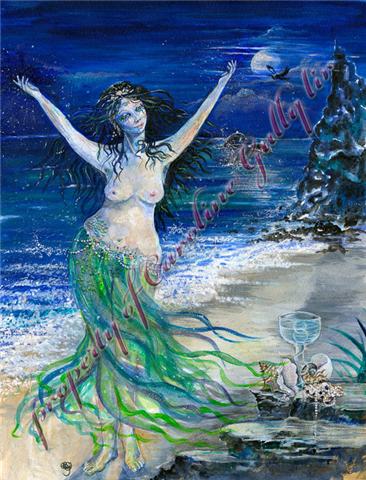
In the rich tapestry of Irish mythology, the figure of Domnu holds a significant place. Known primarily as a goddess of the sea, Domnu is often associated with the depths and the mysterious aspects of water. Her character embodies the ancient Irish belief in the power and danger of the ocean, representing both the nurturing and destructive qualities of the sea. As we delve deeper into her story, we can explore her origins, her role in various myths, and her influence on the Irish cultural landscape.

Origins of Domnu
The origins of Domnu can be traced back to the early myths of Ireland, where she is often linked to the Tuatha Dé Danann, a race of supernatural beings who are considered the gods of the pre-Christian Irish. Domnu is sometimes described as a primordial goddess, one of the first beings to inhabit the earth. Her name is believed to derive from the word “domhan,” meaning “world” or “earth,” which emphasizes her connection to the natural elements.
In some versions of the myth, Domnu is depicted as the mother of the Fomorians, a group of chaotic and monstrous beings that often opposed the Tuatha Dé Danann. This connection places her in a position of power and influence within the mythological hierarchy, as she is seen as the progenitor of a race that represents the darker forces of nature. The Fomorians are often characterized by their struggle against the gods, symbolizing the eternal conflict between order and chaos.
Domnu and the Sea
As a goddess of the sea, Domnu’s association with water is profound. The ocean, in many cultures, is seen as a source of life, providing food and resources. However, it is also a realm of mystery and danger. Domnu embodies this duality, representing the nurturing aspects of the sea while also reminding people of its unpredictable nature. Stories about her often reflect this balance, showcasing her ability to both bless and curse those who venture into her waters.
 Dian Cécht
In some tales, sailors would invoke Domnu’s name before embarking on a journey, seeking her protection against storms and treacherous waters. Her presence in these rituals highlights the respect and reverence the ancient Irish had for the sea and its unpredictable nature. Additionally, offerings were sometimes made to Domnu in hopes of ensuring a bountiful catch or safe passage across the waves, illustrating the deep connection between the goddess and the lives of those who relied on the ocean.
Mythical Stories Involving Domnu
Several myths feature Domnu as a central character, illustrating her importance in the Irish mythological canon. One of the most famous stories involves her relationship with the Fomorians. In this tale, Domnu is said to have given birth to several significant figures among the Fomorians, including Bres, who later becomes a prominent leader of their kind. This lineage showcases her role as a powerful matriarch within the mythological narrative.
Another notable story involves the battle between the Tuatha Dé Danann and the Fomorians. In this myth, Domnu plays a crucial role in the conflict, as her children are often pitted against the gods of the Tuatha Dé Danann. The battles are not merely physical; they symbolize the struggle between the chaotic forces represented by Domnu and the order embodied by the Tuatha Dé Danann. The outcome of these conflicts often reflects the cultural values of the time, highlighting the importance of harmony and balance in the face of chaos.
 Delbcháem
Key Myths Featuring Domnu
- The Birth of Bres: A tale of Domnu giving birth to the Fomorian leader, Bres, and his subsequent rise to power.
- The Battle of Magh Tuireadh: A significant conflict where Domnu’s children face off against the Tuatha Dé Danann.
- The Offering to Domnu: Stories of sailors and fishermen making offerings to Domnu for safe passage and good fortune.
Domnu’s Symbolism
Domnu’s character is rich with symbolism, often representing the dual nature of the sea. She embodies both the nurturing aspects of water, such as fertility and life, and its more destructive qualities, such as storms and chaos. This duality makes her a complex figure within Irish mythology, as she serves as a reminder of the delicate balance between creation and destruction.
Moreover, Domnu’s association with the sea connects her to themes of transformation and change. The ocean is a constantly shifting environment, and Domnu reflects this fluidity. In various myths, her moods and actions can dramatically affect the world around her, emphasizing the idea that nature is both powerful and unpredictable. This aspect of her character resonates with many who have experienced the capriciousness of the sea.
Domnu in Contemporary Culture
While Domnu may not be as widely recognized as other figures in Irish mythology, her influence persists in contemporary culture. Many modern interpretations of Irish mythology seek to revive and reinterpret these ancient stories, bringing characters like Domnu back into the spotlight. In literature, art, and even film, her character can be seen as a representation of the enduring connection between humanity and the natural world.
Furthermore, the resurgence of interest in pagan traditions and nature-based spirituality has led to a renewed appreciation for figures like Domnu. Many contemporary practitioners draw inspiration from her stories, viewing her as a symbol of the sea’s power and mystery. This modern interpretation aligns with a growing awareness of environmental issues, as people seek to reconnect with nature and understand its importance in their lives.
Domnu, as a figure in Irish mythology, represents the complex relationship between humanity and the sea. Her stories, steeped in themes of chaos, order, and the duality of nature, continue to resonate with people today. Through her character, we can explore the ancient Irish understanding of the world, reflecting on our own connections to the natural elements that surround us.