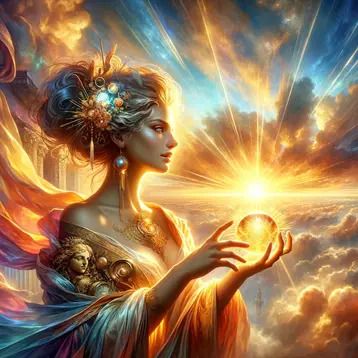
Thea, in Greek mythology, is a fascinating figure often associated with light, sight, and the shining ether of the heavens. She is one of the original twelve Titans, born from the primordial deities Gaia (Earth) and Uranus (Sky). Thea’s significance extends beyond her lineage; she embodies various aspects of the divine and natural world. Her name, which translates to “goddess” or “divine,” reflects her esteemed status among the ancient Greeks. Thea is particularly revered as the mother of the Sun, Moon, and Dawn, showcasing her role as a nurturing figure in the pantheon of Greek deities.
The Family of Thea
Thea is part of a vast and complex family tree in Greek mythology. She is the daughter of Uranus and Gaia, making her a sibling to other powerful Titans like Cronus, Rhea, and Oceanus. This lineage is significant as it connects her to the very fabric of the cosmos. Thea is married to Hyperion, the Titan of light, and together they had three children: Helios (the Sun), Selene (the Moon), and Eos (the Dawn). Each of these children plays a crucial role in the daily cycle of life, symbolizing the importance of light and time in human existence.
 Thebe
ThebeThe relationship between Thea and Hyperion is often depicted as a harmonious union, representing the balance between light and darkness. Their children embody different aspects of light, with Helios illuminating the day, Selene casting her glow at night, and Eos heralding the dawn. This family dynamic illustrates the ancient Greeks’ understanding of the natural world and the importance of celestial bodies in their mythology.
Key Family Members
- Uranus: The personification of the sky and one of the primordial deities.
- Gaia: The Earth goddess, mother of the Titans.
- Hyperion: The Titan of light, husband of Thea.
- Helios: The Sun god, son of Thea and Hyperion.
- Selene: The Moon goddess, daughter of Thea and Hyperion.
- Eos: The goddess of dawn, daughter of Thea and Hyperion.
The Role of Thea in Greek Mythology
Thea’s role in Greek mythology is multifaceted. As a Titaness, she embodies the essence of light and is often associated with vision and enlightenment. This association makes her an important figure in various myths and stories. The ancient Greeks believed that Thea was responsible for providing light to the world, both literally and metaphorically. Her influence extends to the realm of knowledge, where she is seen as a source of inspiration and clarity.
In addition to her association with light, Thea also represents the nurturing aspect of the divine. As the mother of Helios, Selene, and Eos, she is often depicted as a protective figure, guiding her children as they traverse the skies. This nurturing role highlights the importance of maternal figures in mythology and reflects the ancient Greeks’ reverence for motherhood. Thea’s presence in the myths serves as a reminder of the vital role that women played in the ancient world, both as caretakers and as powerful deities.
 Thelxinoe
Symbolism of Thea
- Light: Thea symbolizes illumination and enlightenment.
- Vision: She is associated with sight and perception.
- Nurturing: Thea represents the protective and caring aspects of motherhood.
- Celestial Bodies: Her children symbolize the Sun, Moon, and Dawn, highlighting her connection to the cosmos.
Thea in Literature and Art
Thea’s influence extends beyond mythology into literature and art. In ancient texts, she is often mentioned alongside her children and other Titans, emphasizing her importance in the divine hierarchy. Poets and playwrights of ancient Greece frequently referenced her in their works, showcasing her role as a goddess of light and vision. For instance, Hesiod, a prominent ancient Greek poet, includes Thea in his works, highlighting her divine attributes and family connections.
In art, Thea is often depicted alongside her husband Hyperion and their children. Artists of various periods have portrayed her in different forms, sometimes as a radiant figure representing the sun or moon. These artistic representations often emphasize her beauty and grace, reflecting the ancient Greeks’ admiration for her divine qualities. Thea’s imagery is intertwined with themes of light and nature, making her a popular subject in both sculpture and painting.
Notable Artistic Representations
- Classical Sculpture: Thea is depicted as a radiant figure, often surrounded by celestial symbols.
- Paintings: Artists portray her in scenes with Helios and Selene, emphasizing her role as a mother.
- Literary References: Poets like Hesiod and Homer include her in their works, highlighting her significance.
Thea’s Legacy
The legacy of Thea is profound in the context of Greek mythology and beyond. As a Titaness, she represents the ancient Greeks’ understanding of the cosmos and the importance of light in their lives. Her children, Helios, Selene, and Eos, continue to be significant figures in mythology, each representing different aspects of the day and night cycle. The stories surrounding Thea and her family have influenced countless generations, shaping cultural narratives and artistic expressions.
 Themis
In modern interpretations, Thea’s legacy persists in various forms. Her association with light and enlightenment resonates with contemporary themes of knowledge and understanding. Additionally, her role as a nurturing mother figure continues to be celebrated in literature and art, reflecting the timeless nature of her character. Thea’s influence can be seen in various aspects of modern culture, from literature to film, where themes of light and maternal protection are explored.
Modern Interpretations
- Literature: Contemporary writers often draw on Thea’s symbolism in their works.
- Film and Television: Characters inspired by Thea appear in various media, emphasizing her nurturing qualities.
- Art: Modern artists continue to explore themes of light and motherhood in their representations of Thea.
Thea in Comparative Mythology
When examining Thea within the broader context of comparative mythology, her character shares similarities with various deities from other cultures. Many mythologies feature goddesses associated with light, motherhood, and the celestial realm. For instance, in Roman mythology, the goddess Aurora is akin to Eos, representing the dawn. Similarly, in Hindu mythology, the goddess Ushas embodies the dawn and shares characteristics with both Eos and Thea.
The themes of light and motherhood are universal, appearing in many cultures worldwide. These similarities suggest a shared human experience, where light symbolizes knowledge and enlightenment, while motherhood represents nurturing and protection. Thea’s role as a divine figure transcends cultural boundaries, highlighting the importance of these themes in the human narrative.
Similar Deities in Other Cultures
- Aurora: Roman goddess of dawn, akin to Eos.
- Ushas: Hindu goddess representing dawn and light.
- Amaterasu: Japanese sun goddess, embodying light and divinity.
Thea’s Worship and Cult
While Thea may not have had extensive temples or dedicated cults like some of the more prominent Olympian gods, she was still revered in certain contexts. The ancient Greeks recognized her significance in the natural world and the cosmos. As a Titaness associated with light, Thea was likely invoked in rituals and prayers related to the sun and moon. Farmers, in particular, may have sought her blessings for favorable weather and bountiful harvests, emphasizing her connection to the cycles of nature.
In addition to agricultural rituals, Thea’s influence may have extended to the arts and sciences. Scholars and philosophers of ancient Greece often sought enlightenment and knowledge, which could be seen as a form of worship. Thea’s association with vision and clarity made her an important figure for those seeking understanding in various fields. Although her worship may not have been formalized, her presence was felt in the everyday lives of the ancient Greeks.
Forms of Worship
- Rituals: Farmers may have performed rituals to seek Thea’s blessings for their crops.
- Prayers: Individuals likely invoked her name when seeking knowledge or enlightenment.
- Festivals: While not dedicated solely to Thea, festivals celebrating the sun and moon may have included her in the celebrations.
Thea in Modern Popular Culture
Thea’s influence can be seen in modern popular culture, where her character and attributes are reinterpreted in various forms of media. In literature, she often appears as a symbol of light and wisdom, guiding characters on their journeys. Her role as a nurturing mother figure resonates with contemporary themes of empowerment and protection, making her a relatable character for modern audiences.
In television and film, characters inspired by Thea are frequently depicted as strong, independent women who embody qualities of light and enlightenment. These portrayals reflect the timeless nature of her character and her relevance in today’s society. The themes associated with Thea, such as the importance of knowledge and the nurturing aspects of motherhood, continue to resonate with audiences, showcasing her enduring legacy in popular culture.
Examples in Popular Culture
- Books: Thea is often referenced in fantasy literature, symbolizing wisdom and light.
- Films: Characters inspired by Thea appear in various genres, emphasizing her nurturing qualities.
- Television Shows: Modern series feature characters that embody Thea’s attributes, showcasing her influence.
Thea’s Influence on Language
The name Thea itself has permeated language and culture, often used to denote a sense of divinity or brilliance. The term “theory,” derived from the Greek word “theoria,” which means contemplation or speculation, is linked to the idea of understanding and enlightenment, reflecting Thea’s association with vision and knowledge. This linguistic connection highlights the lasting impact of her character on the way we think and communicate.
In various languages, the name Thea or its variations are used to denote light, divinity, or goddess-like qualities. This usage underscores her significance as a symbol of enlightenment and inspiration. The enduring nature of her name in contemporary culture speaks to the timelessness of her attributes and the universal themes she represents.
Language Connections
- Theory: Derives from “theoria,” connected to contemplation and understanding.
- Thea: Used in various languages to symbolize light and divinity.
- Modern Names: Variations of Thea appear in names across cultures, often representing similar themes.
Thea in Academic Studies
The study of Thea and her role in Greek mythology has attracted the attention of scholars and researchers over the years. Various academic disciplines, including mythology, literature, and cultural studies, have explored her significance and the themes associated with her character. Scholars analyze her representation in ancient texts, art, and modern interpretations, seeking to understand the cultural and historical contexts that shaped her image.
Through academic research, Thea’s character is examined in relation to broader themes in mythology, such as the duality of light and darkness, the role of women in ancient societies, and the importance of celestial bodies in human understanding. These studies contribute to a deeper appreciation of Thea’s significance and the ways in which her character has evolved over time.
Academic Perspectives
- Mythological Analysis: Scholars explore Thea’s role within the context of the Titan family and her influence on Greek cosmology.
- Literary Studies: Thea’s representation in ancient texts is analyzed for its cultural implications.
- Cultural Studies: Researchers examine the enduring legacy of Thea in modern interpretations and popular culture.
Thea and Feminine Power
Thea’s character also represents themes of feminine power and the divine feminine in mythology. As a mother figure, she embodies the nurturing aspects of femininity while also holding a significant position within the Titan hierarchy. This duality reflects the complexities of women’s roles in ancient Greek society, where they were often seen as both caretakers and powerful figures in their own right.
Thea’s influence extends to discussions about gender and power in mythology. Her character challenges traditional notions of femininity, showcasing a powerful woman who plays a crucial role in the cosmic order. This portrayal contributes to ongoing conversations about the representation of women in mythology and their impact on cultural narratives.
Feminine Themes
- Nurturing: Thea embodies the protective and caring aspects of motherhood.
- Power: As a Titaness, she holds a significant position in the divine hierarchy.
- Complexity: Thea’s character challenges traditional notions of femininity and power.